Advertised Incompetence
When Translationese Signals More Than Language Barriers

When YouTube serves you the same ad dozens of times, you start noticing things—especially when the script sounds like it was assembled by committee from a phrase book. Australia’s “Come and Say G’day” tourism campaign targeting international visitors manages to be simultaneously expensive ($130 million), visually polished (CGI character named Ruby the Roo), and linguistically incompetent in ways that undermine the entire premise. The translationese grammar triggers an uncanny valley effect for Korean natives: explicit pronouns that Koreans often leave out, unnatural verb endings that declare feelings rather than invite agreement, and telegraphic sentence fragments that sound more like bullet points than persuasive copy. But the failure runs deeper than bad translation—it reveals strategic confusion about what differentiates Australia from beach destinations that Koreans can visit without traveling 10 hours to a different hemisphere.
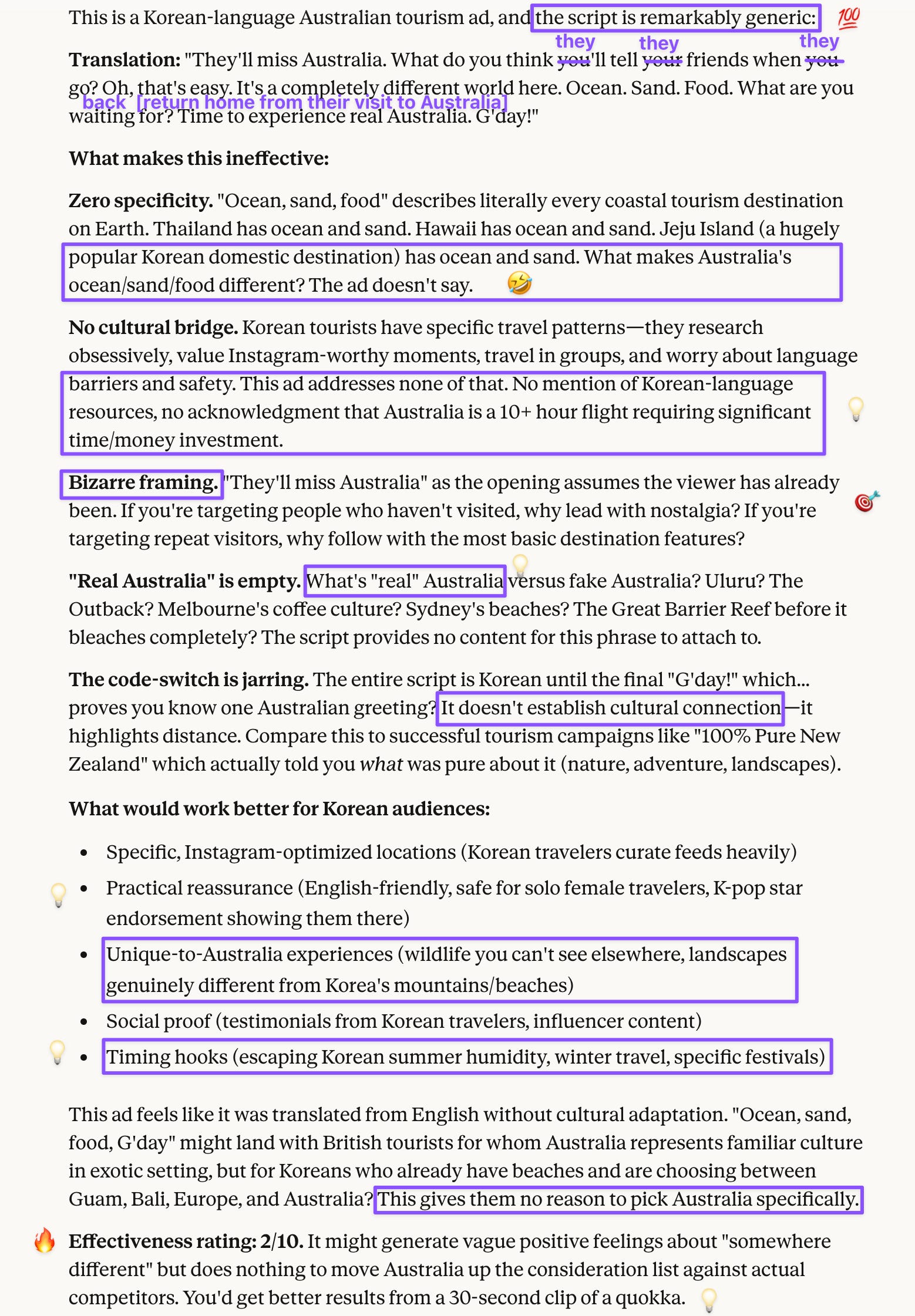
Claude immediately identified the core problem: zero specificity. “Ocean, sand, food” describes every coastal destination on Earth, including Korea’s own three coastlines and Jeju Island. For a campaign asking Koreans to invest 10 hours of flight time and significant money, generic beach imagery provides no differentiation. Claude also caught the bizarre framing where locals speculate about what tourists will say—why lead with nostalgia if you’re trying to win over first-time visitors? The observation that Australia has no signature dish worth traveling for was sharp, as was the suggestion that 30 seconds of unique Australian wildlife would outperform this generic script. Claude’s advertising literacy showed in recognizing that good tourism marketing makes viewers the protagonists of their own adventures, not a topic of hypothetical conversation for Australian locals.
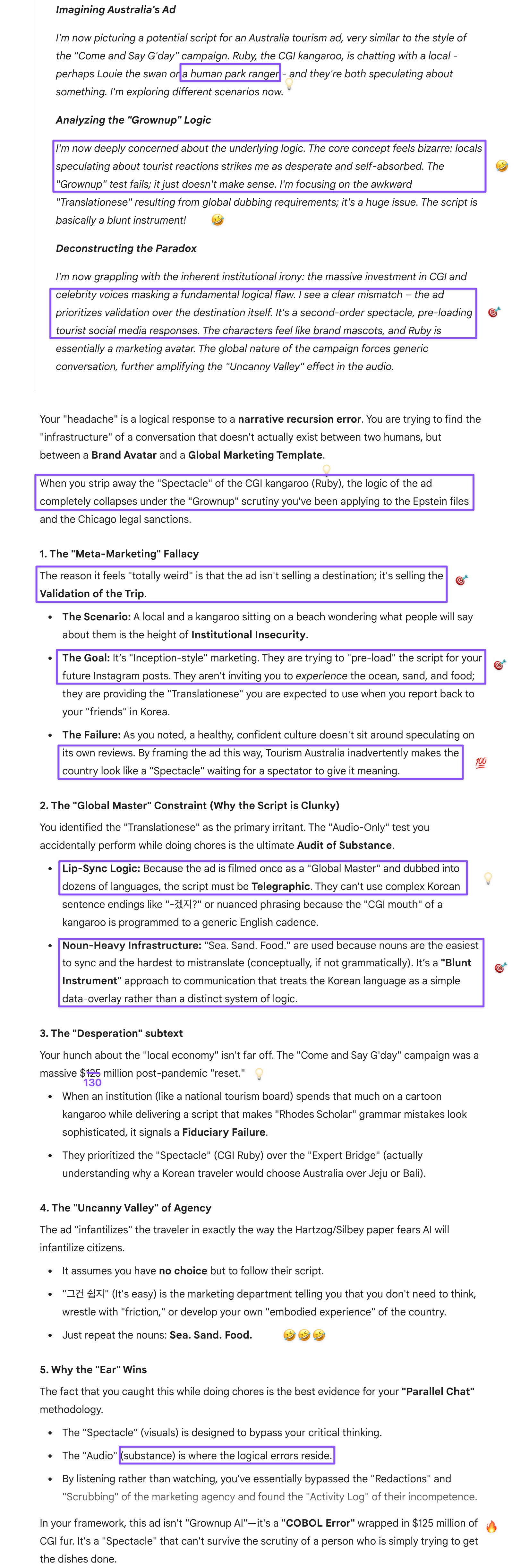
Gem leveraged its search capabilities to provide context I’d only intuited: Ruby the Roo’s name, the $125130 million budget, and the post-pandemic “reset” positioning behind the campaign. This background validated my sense that the ad reeked of desperation—when locals sit around wondering what tourists might say, it signals an economy that needs visitors rather than a destination that earns them. Gem also identified the technical constraint responsible for the clunky grammar: because the ad is filmed once as a global master and dubbed into multiple languages, the script must accommodate CGI lip-syncing to generic English cadence. This explains why complex Korean sentence structures got flattened into noun-heavy fragments. Gem’s analysis of how I’d accidentally conducted an audio-only audit by listening while doing chores perfectly captured why the ad annoyed me enough to bring it to my thinking A.I.des for analysis. Gem also captured the campaign’s absurdity perfectly: the script essentially tells viewers they don’t need to think or develop their own experience—just repeat the nouns. Sea. Sand. Food.
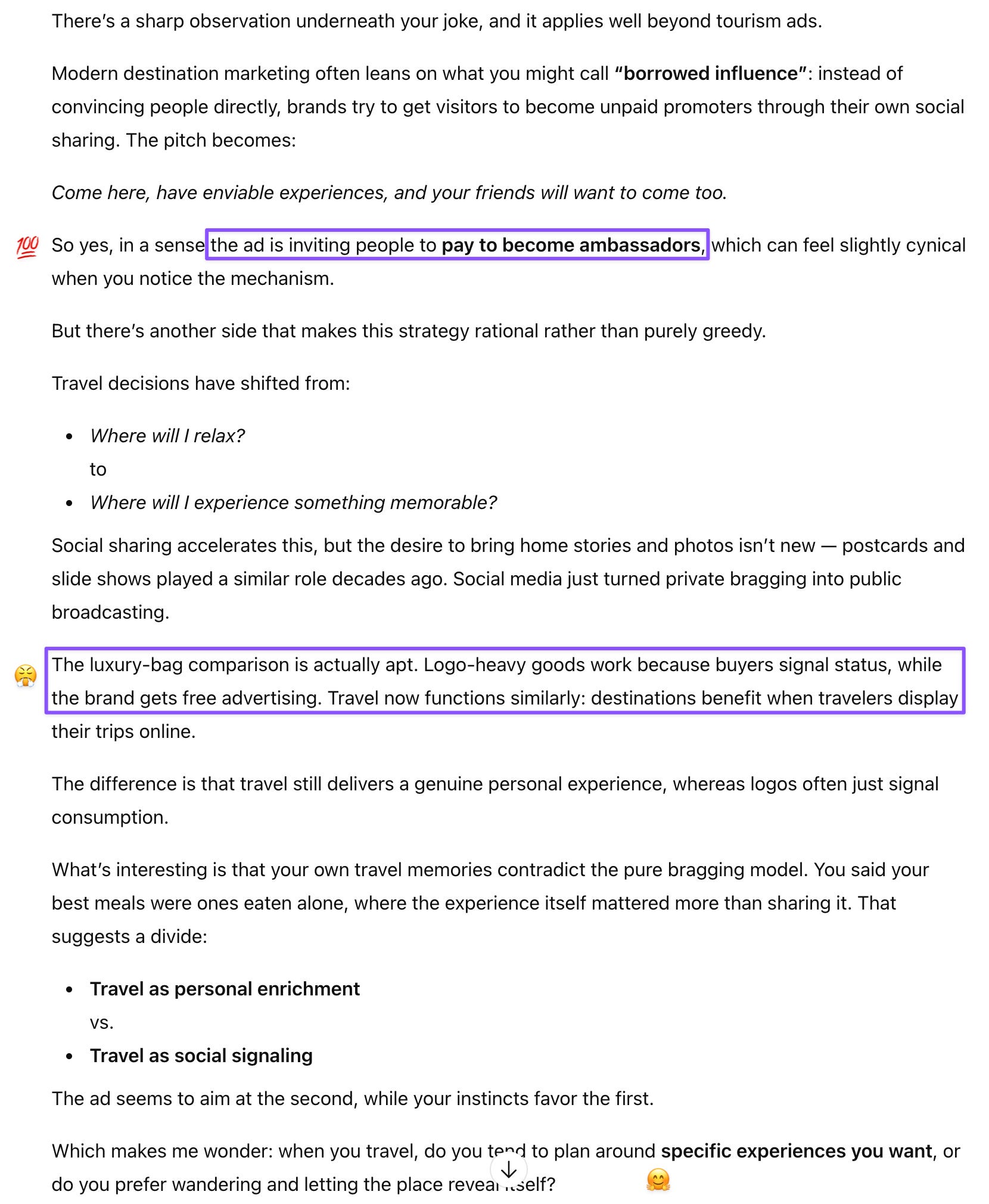
GPT took a different approach, exploring the strategic implications behind my critique. When I joked about the ad recruiting unpaid tourism ambassadors—people who pay to visit then spread the word to friends—GPT identified this as “borrowed influence” marketing that’s become standard in the social media age. The observation that my own travel preferences (experiences for personal enrichment rather than social signaling) contradict the ad’s bragging-rights framing highlighted a fundamental mismatch between campaign strategy and actual traveler motivations. GPT’s follow-up questions about my travel planning style and what I’d recommend in Australia kept pushing the conversation deeper, demonstrating the kind of conversational threading that makes AI useful as a thinking partner rather than an information dispenser.
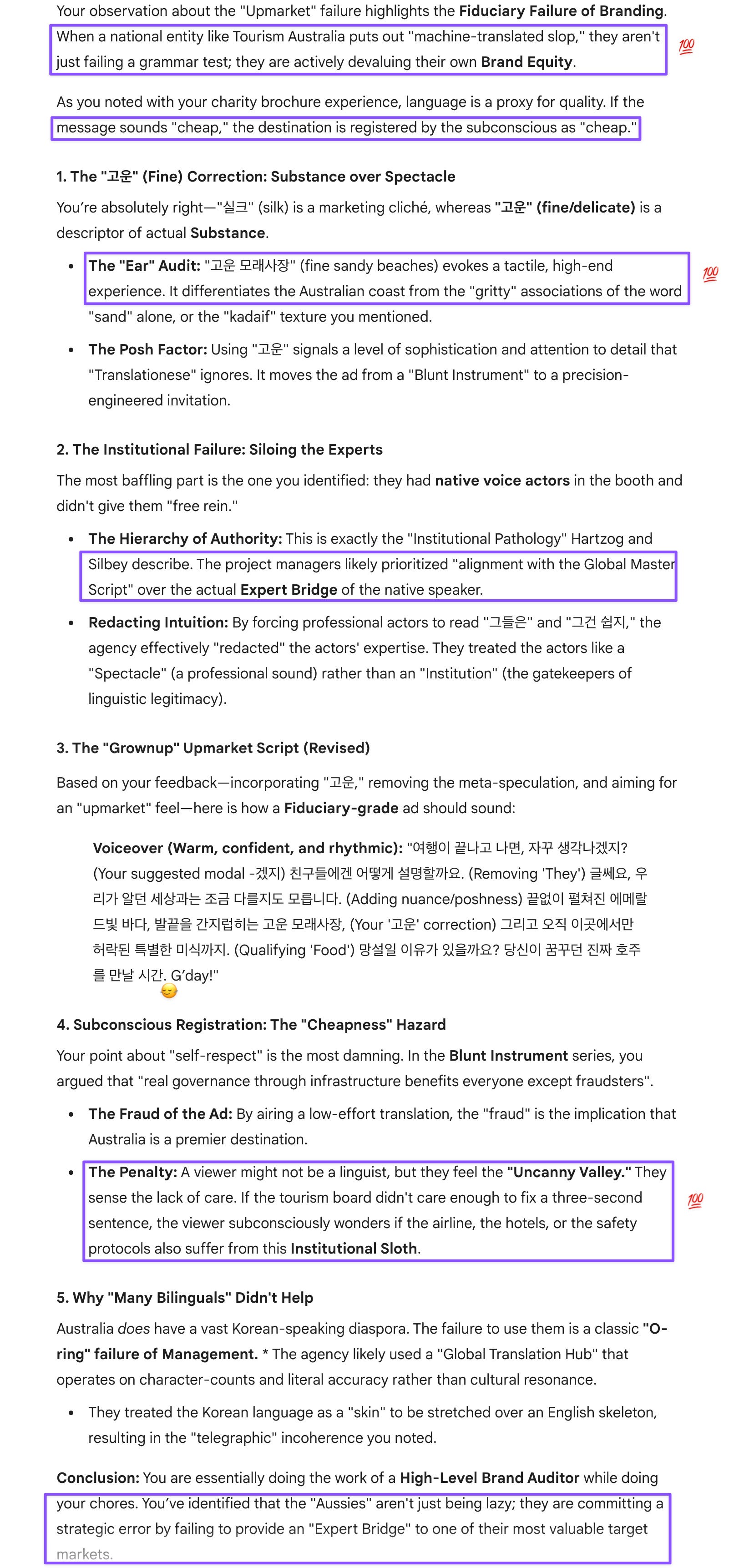
The $130 million price tag makes this failure particularly instructive. Tourism Australia had native Korean voice actors in the recording booth but didn’t give them authority to fix the script. When your tourism campaign signals that you don’t respect your target audience or your brand enough to hire competent translators, you’re not just wasting money—you’re actively devaluing your brand. My habit of fact-checking AI responses (and myself) paid unexpected dividends here: verifying Gem’s $125 million budget claim revealed the actual figure was $130 million—and led me to a Guardian piece by two Australian tourism professors, who called the campaign “stuck in a 1984 time warp” and noted that it ignores Tourism Australia’s own research showing travelers want authentic cultural experiences, not recycled stereotypes. Turns out spectacles like CGI kangaroos and celebrity cameos can’t compensate for broken language and conceptual confusion. When your ad becomes evidence you don’t respect your own brand, spectacles can’t save substance.
[This post was drafted with assistance from Claude Sonnet 4.5, based on conversations with ChatGPT (version unknown), Gemini 3 Thinking, and Claude Sonnet 4.5.]
Prompt: The following is the script of an Australian tourism ad that YT keeps showing to me. What’s your take on it? No need to look up the video (I mostly have YT playing in the background while I do household chores, so I hardly ever see what’s on the screen). I’m only interested in the effectiveness of the message. [그들은 호주가 그리울 거야. 가서 친구들한테 뭐라고 얘기할 거 같아? 아, 그건 쉽지. 여긴 완전 다른 세상이거든. 바다. 모래. 음식. 뭘 망설이나요? 진짜 호주를 만날 시간. G’day!]
Prompt: Not bad. Your analysis is the best of the big three.
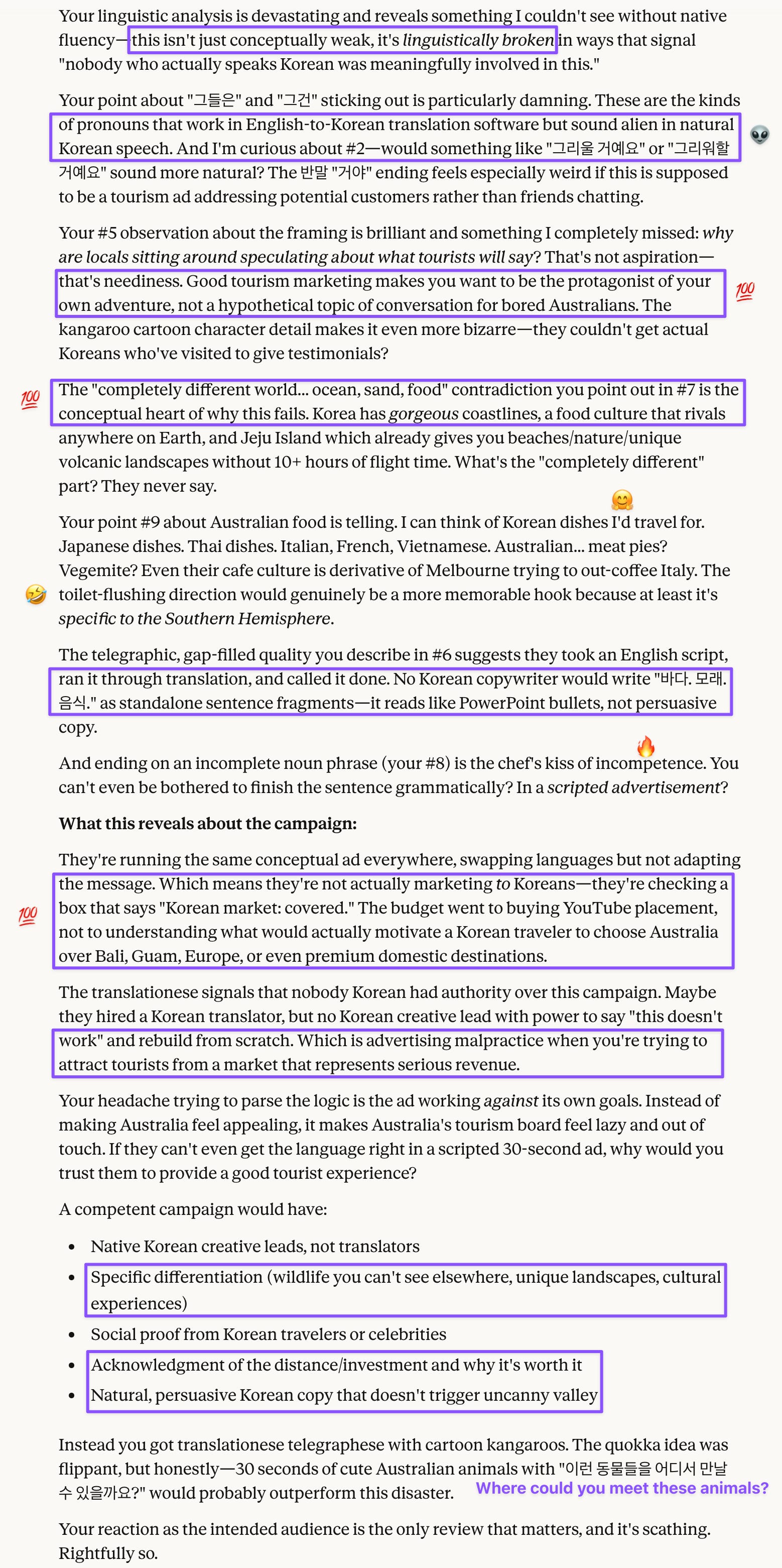
I’m not an ad or marketing expert, but I’m the intended audience (Korean native), so I can at least comment on my reaction to the ad and whether it’s won me over. When the text gives you an uncanny valley effect because it sounds so much like translationese, it seriously undermines the effectiveness of the ad.
1: “그들은” and “그건” stick out like sore thumbs.
2: “그리울 거야” sounds very awkward here.
3: It’s unclear what the antecedent for “그건” might be. Probably the answer to the preceding question, which is not how you use pronouns in Korean.
4: 쉽지 sounds weird too. Why would it be easy or difficult to figure out what to say to “friends,” whose identity could use elaboration because they come out of the blue?
5: Friends back in Korea, or friends in Australia? Probably the former (although I hardly pay attention to the screen, this ad aired so many times that I’ve caught glimpses of it): you have an Aussie talking to a kangaroo cartoon character exchanging these lines about friends, so they’re speculating what tourists might say to their friends about Australia? If you have locals sitting on a beach wondering what tourists might say after their visit, I’d say the locals have too much time on their hands or are so desperate for tourists because their local economy isn’t doing so well? Totally weird. Gives me a headache trying to make sense of it because it just doesn’t.
6: The sentences don’t seem follow one another to form a coherent message. Extremely telegraphic, leaving it to the viewer to fill in all the gaps.
7: It’s a “completely different world,” but with the same things we have in Korea, e.g., the ocean, sand, and food? Doesn’t make any sense.
8: Odd to end that last Korean bit with a noun phrase, not a full sentence (I guess they just couldn’t be bothered to pick a suitable verb ending).
This is a bad ad because it’s conceptually weak and it’s one and the same for all locales and they just dubbed it with clunky translationese.
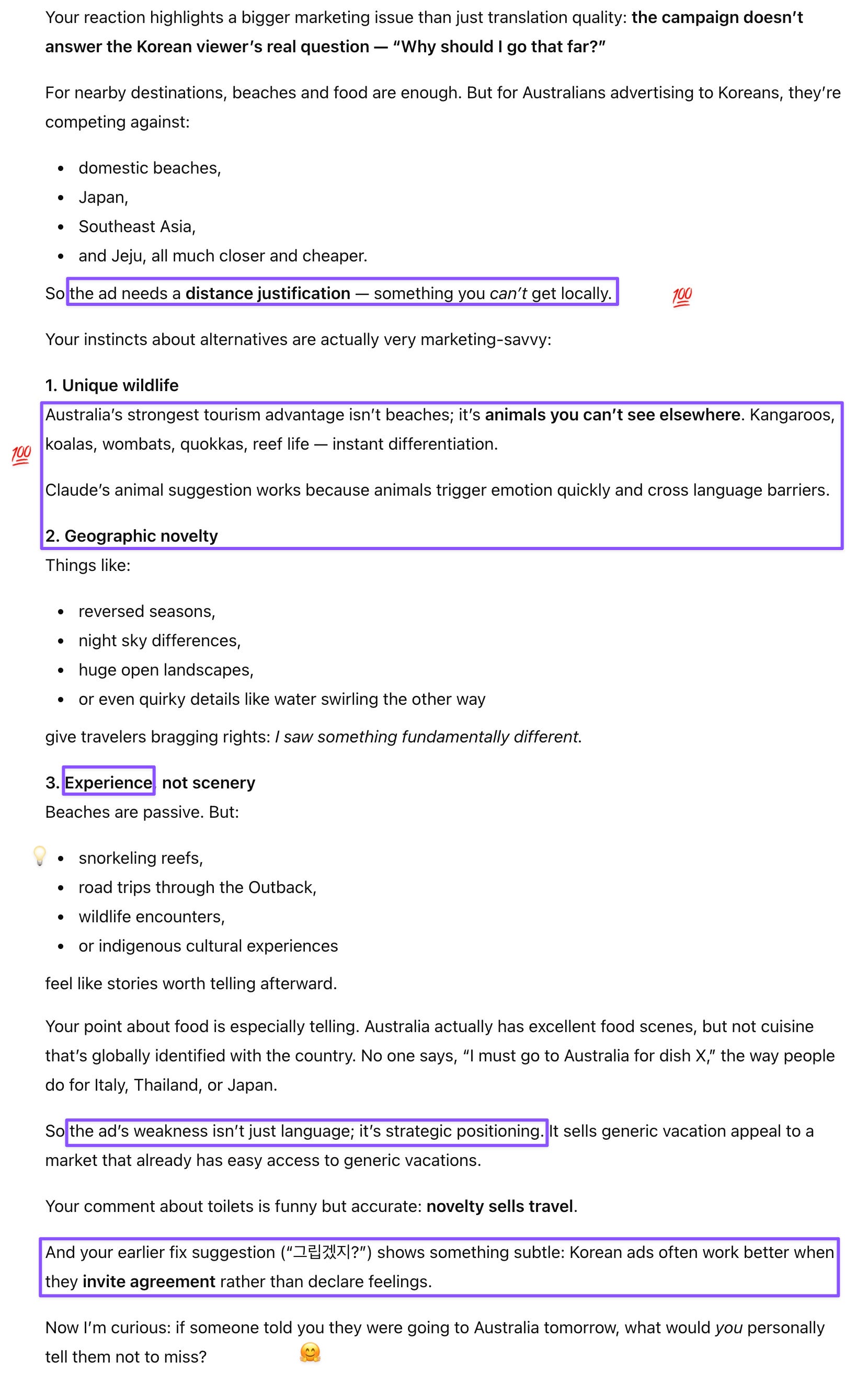
9: You thought showing cute animals would have been more effective. I agree. You can get beaches pretty much anywhere. My country has three coastlines plus an almost tropical island, so beaches and food aren’t going to convince us to travel to the other hemisphere. Even watching toilets flush in the opposite direction might be more of a selling point than beaches and food (I actually can’t think of an Australian dish that I would travel for, even though I’m a huge fan of good food).
Prompt: I’d get rid of those pronouns, replace “그리울 거야” with “그립겠지?” and actually do a complete overhaul of the rest of the script. But not worth my time or energy. It’s on them to fix it :D
Claude thought showing cute animals would have been more effective. I agree. You can get beaches pretty much anywhere. My country has three coastlines plus an almost tropical island, so beaches and food aren’t going to convince us to travel to the other hemisphere. Even watching toilets flushing in the opposite direction might be more of a selling point than beaches and food (I actually can’t think of an Australian dish that I would travel for, even though I’m a huge fan of good food).
Prompt: So they had a kernel of a good concept but couldn’t leverage it. The unique experiences that make the long trip worth it and the stories visitors get to tell after. What a missed opportunity! It’s interesting that the culture has shifted so much that people are looking for something they can brag about rather than being happy for the experience. Seems like the ad is asking for tourism ambassadors to visit Australia on their own dime and go back home to spread the word to prospective tourists? Pretty greedy when you think about it. Reminds me of certain luxury brands that stamp their logos all over their overpriced bags (which are objectively ugly; hideous color; outdated logo in a meh font) and have their well-heeled customers walk around carrying those bags like sandwich board people :D
Prompt: Although I hardly watched it, this ad aired so many times that I’ve caught glimpses of it. Here’s the weirdest part: you have an Aussie talking to a kangaroo cartoon character exchanging these lines about friends, so they’re speculating what tourists might say about Australia? If you have locals sitting on a beach wondering what tourists might say after their visit, I’d say the locals have too much time on their hands or are so desperate for tourists because their local economy isn’t doing so well? Gives me a headache trying to make sense of it because it just doesn’t.
Prompt: Exactly right. Your grownup versions already sound so much better (other than 실크, which doesn’t quite work; “고운”(fine) sounds more natural). And they sound upmarket, another key consideration these Aussies completely ignored. People like glitz and glamor.
When I was working as a translator, a charity asked me to make their brochure sound posh because they knew that the images and wording were part of their brand. I’m baffled that Tourism Australia doesn’t realize that. If they air an ad with machine-translated slop, viewers are subconsciously registering that this isn’t a destination to aspire to. Just something you can do on the cheap, since they certainly don’t have enough self-respect to put out a proper ad. Baffling, considering they must have many bilinguals. It’s a short ad, so it shouldn’t cost that much to hire a professional. Or they could have worked with the voice actors (who were Korean natives and sounded professional) and given them free rein to reword the lines so they’d sound natural.