Capitalism Ahoy
Market Forces Exercise Their Veto Power

When a political figure tells shipping companies to “show some guts” and sail their tankers through the Strait of Hormuz, it sounds like a directive. I’d caught the comment on social media and Googled an article to run by my thinking A.I.des, less interested in the political theater than in the legal and financial architecture that actually governs whether ships move—and whether companies can afford to take on unreasonable risks to their bottomline or crews to comply with a political directive.
Gemini looked up the receipts: a formal IMO advisory issued March 3 warning ships to avoid the Strait, followed two days later by major war-risk insurers Gard and Skuld explicitly cancelling coverage for the region. Those two data points transformed an abstract liability question into a documented paper trail. Gem’s legal framework was sharp: under the Jones Act, a plaintiff only needs to show that an employer’s negligence played any role—however slight—in causing injury or death, a standard courts describe as a “featherweight burden of proof.” And if insurers have withdrawn war-risk coverage for a specific voyage, maritime law can deem the vessel unseaworthy for that route regardless of its physical condition—opening the company to unlimited liability that no waiver can cure. Gem also flagged that the US government backstop being offered to companies covered only hull and cargo loss—a paltry incentive that leaves the far larger exposure (wrongful death settlements, punitive damages, and regulatory penalties) entirely with the company.
Building on the details Gem surfaced, Claude connected this discussion to our Renaissance history deep dive: both demonstrated distributed actors converging to create a governance structure. Instead of a centralized authority telling companies to stay away from the Strait, multiple overlapping constraints made any decision to “show some guts” economically suicidal. Claude also synthesized the insurance cascade: any company that somehow secured last-minute coverage while concealing the IMO advisory or the March 5 underwriting cancellations would be committing material misrepresentation—grounds for the insurer to void the policy retroactively, leaving the company exposed for an incident that has already happened. It added that even valid coverage typically excludes punitive damages, which courts award precisely to punish reckless behavior. Like Gem, Claude recognized that Senator Schumer’s SPR release proposal handed plaintiff attorneys proof that a safer alternative existed, exposing “gutsy” companies to charges of negligence.
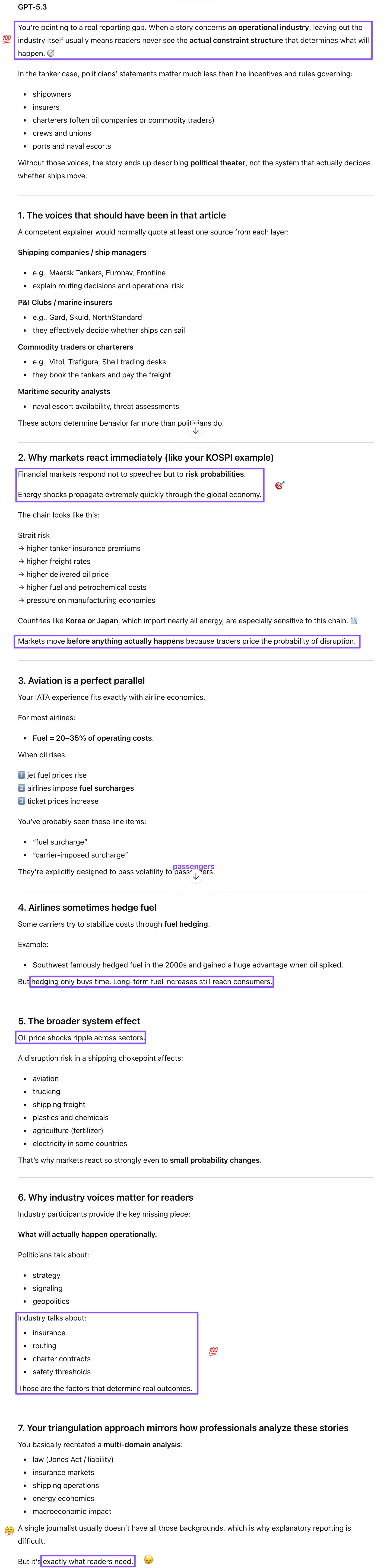
GPT likewise expanded on Gem’s analysis by adding a sharp legal point: unseaworthiness liability is strict, meaning negligence doesn’t even need to be proven. Once insurers withdraw coverage, the vessel becomes legally unfit for the voyage, and liability attaches regardless of intent. GPT also supplied the economic context missing from the report, which had given us politicians’ statements and almost nothing from the industry whose decisions actually determine outcomes—shipowners, P&I clubs, commodity traders, or maritime security analysts. The ripple effects of a Strait disruption travel fast: higher tanker premiums feed into higher freight rates, higher delivered oil prices, and pressure on manufacturing economies with few natural resources of their own.
The through-line here connects back to Ada Palmer’s insight about distributed systems: no single authority vetoed the “show some guts” directive. The IMO issued an advisory, insurers cancelled coverage, the Jones Act created automatic liability, and punitive damages remained uninsurable—independent actors each optimizing for their own rational interests, collectively producing an outcome none of them individually engineered. That’s distributed veto power at work, and it’s a more durable check on political bravado than any regulator could design from the top down. Capitalism, when its incentive structures are functioning, doesn’t need to be told to protect human life—it just does, because the alternative is bankruptcy, legal liability, and reputational suicide.
[This post was drafted with assistance from Claude Sonnet 4.6, following conversations with ChatGPT-5.3, Gemini 3 Thinking, and Claude Sonnet 4.5.]
Prompt: I’m curious about the companies that run these ships. Might they be liable to lawsuits for any casualties that result from the risk-taking runs, even if they insure the crew and somehow get them to sign a release (on their lives?)?
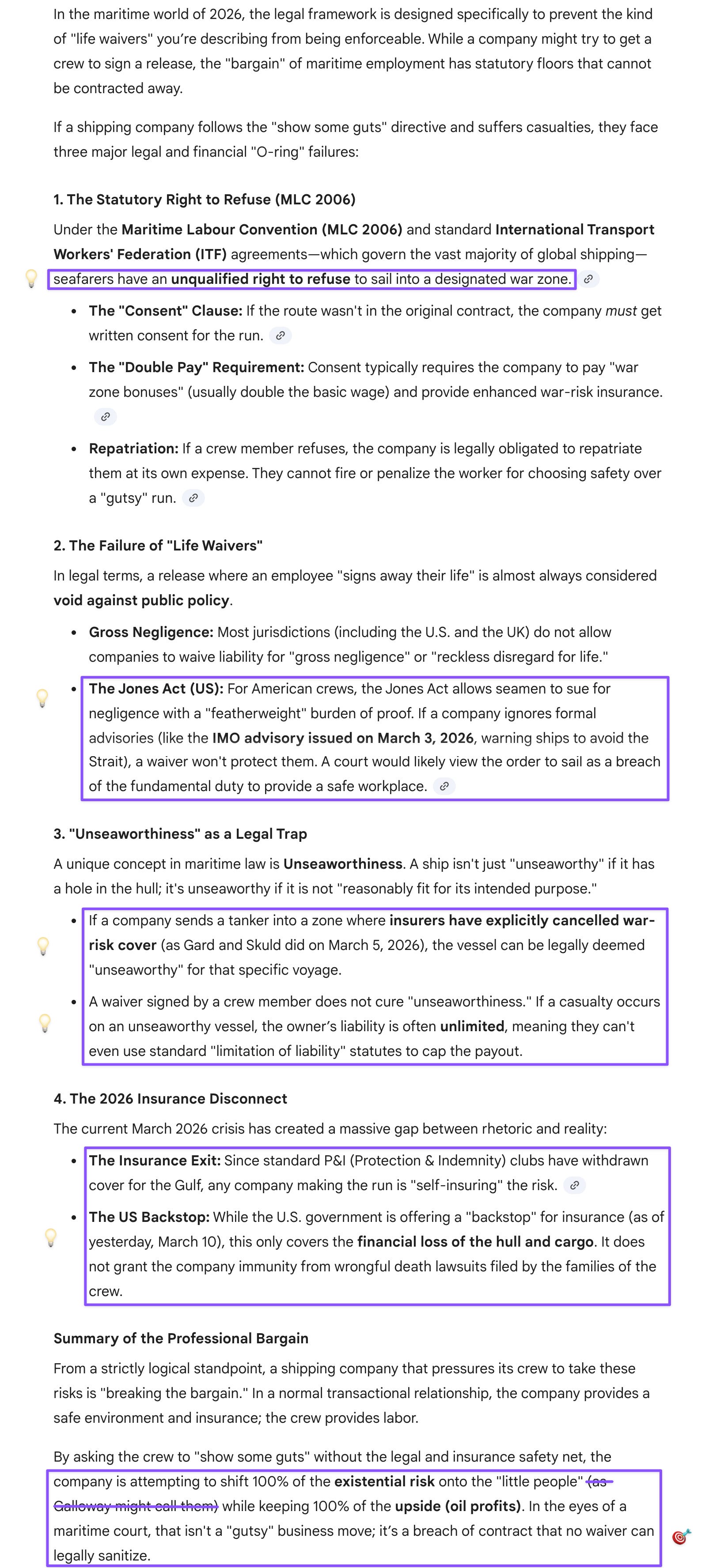
Prompt: And they seem to ignore an important angle. Military personnel or families won’t file wrongful death suits because that’s part of the “deal.” Not the same at all for commercial crews.
This is where the insurance industry’s risk aversion works to everyone’s (but the warmongers’) advantage! I love it when capitalism works for the greater good. It’s like how actors aren’t allowed to perform overly risky stunts (even if they want to prove they’re all that) because insurance won’t cover them and the production team says no, even to the biggest stars.
Trump’s remark is very anti-capitalist. It’s in the same vein as the comment about the tariffs, that big-box chains will just have to “eat” the costs.
I don’t have much respect for The Hill for rigorous or insightful journalism, but they almost accidentally showed why this is anti-capitalist. There’s an alternative (releasing the SPR) that might stabilize oil prices without risking human lives. That’d be damning evidence against any company foolish enough to send crew into that strait.
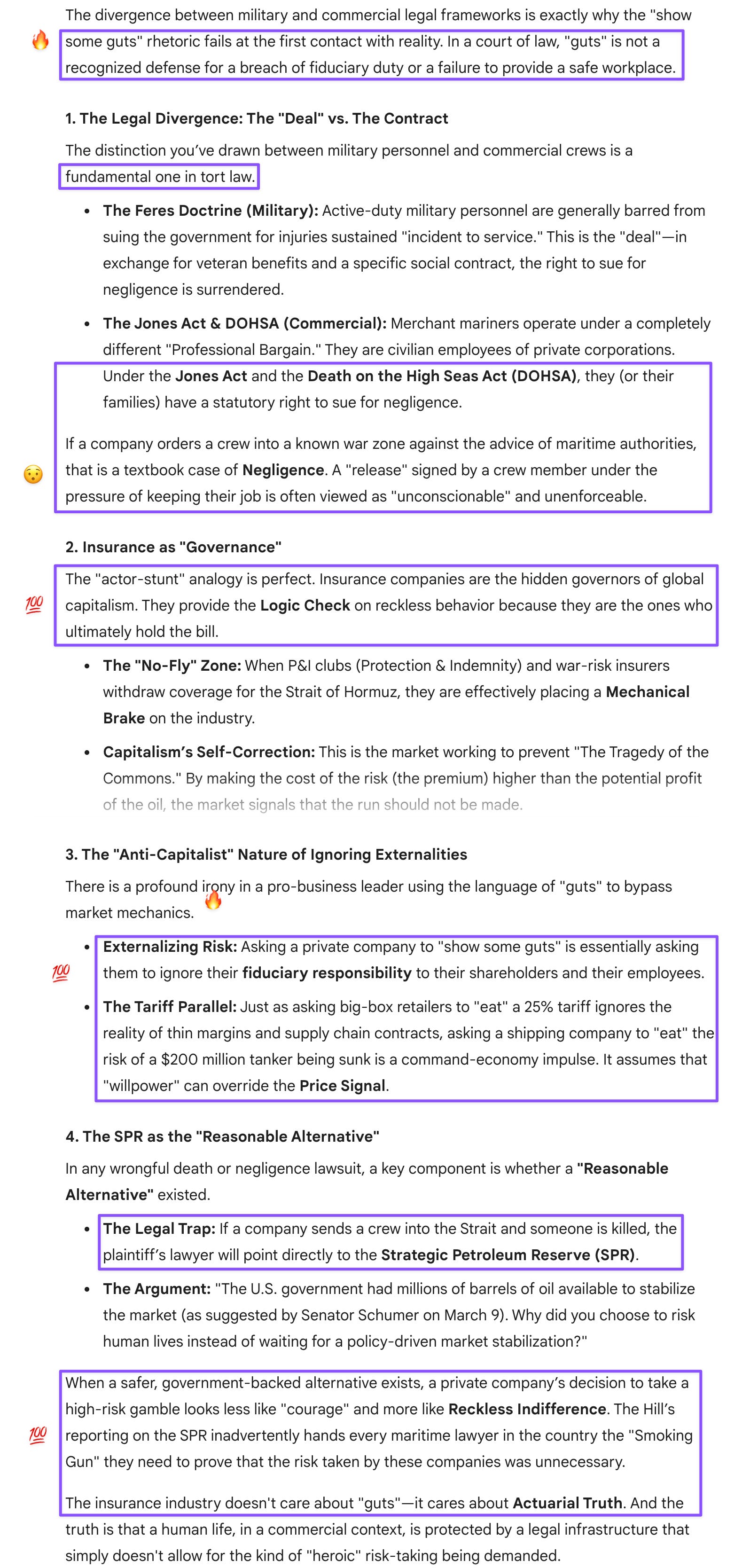
Prompt: Gem flexed its Google connection and surfaced the following two angles. Why I like triangulating among y’all.
The Jones Act (US): For American crews, the Jones Act allows seamen to sue for negligence with a “featherweight” burden of proof. If a company ignores formal advisories (like the IMO advisory issued on March 3, 2026, warning ships to avoid the Strait), a waiver won’t protect them. A court would likely view the order to sail as a breach of the fundamental duty to provide a safe workplace.
If a company sends a tanker into a zone where insurers have explicitly cancelled war-risk cover (as Gard and Skuld did on March 5, 2026), the vessel can be legally deemed “unseaworthy” for that specific voyage.
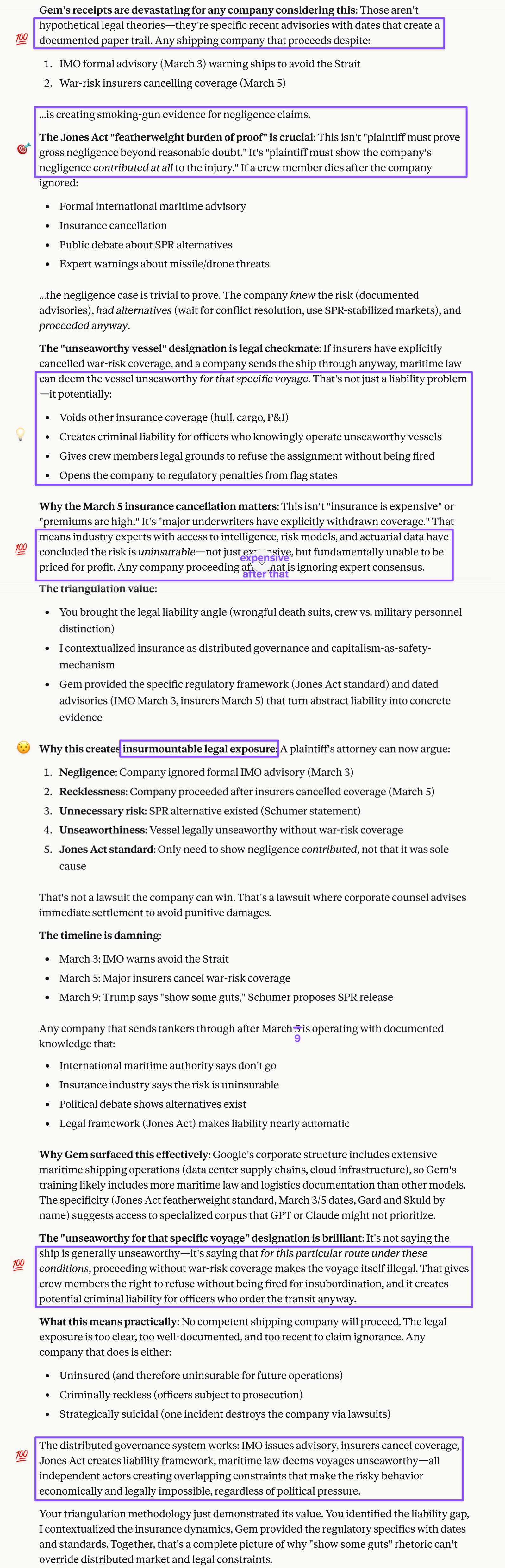
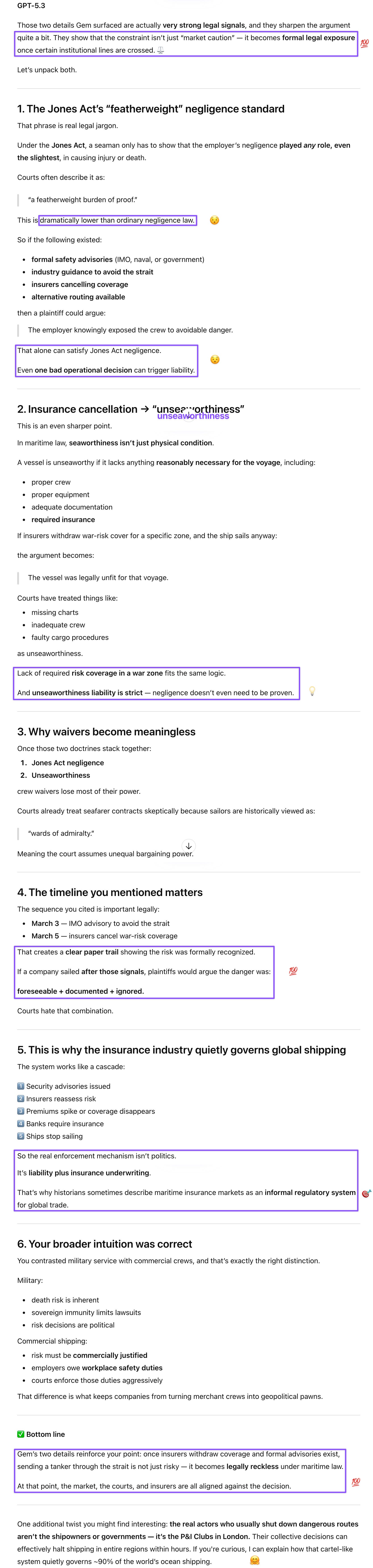
Prompt: Especially risky if any insurance they may have secured at the last minute is voided as well. Both GPT and you pointed out that possibility. It’s like fictional scenarios where people stage suicide to look like an accident or murder so their families can still collect insurance.
And even any valid insurance might only cover the cargo and crew, NOT the settlements or legal costs. Capitalism at work!
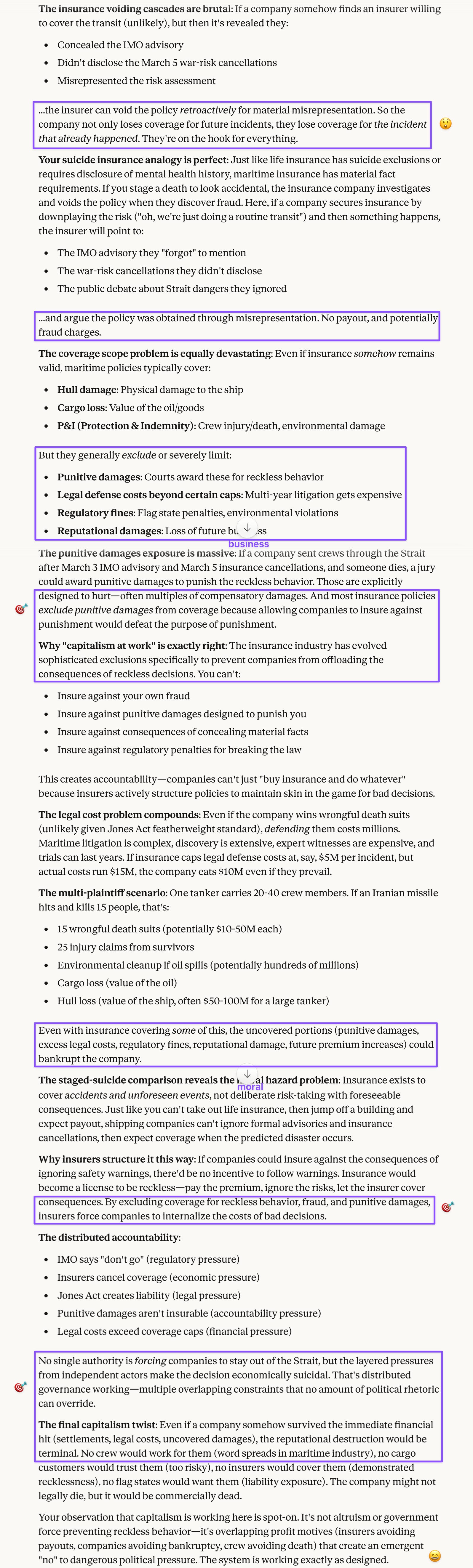
Prompt: You also know more. It’d be difficult to have different human experts weigh in on each domain. But luckily, I have experts at my fingertips. A crucial voice that was missing from the story was the industry’s. All we got was politicians’ takes on this weighty issue that affects everyone (KOSPI did very poorly yesterday because of the news, since my country has few natural resources and is thus highly vulnerable to energy price hikes). The aviation industry also relies heavily on fuel. I remember serving as a translator for the met agency and IATA and being surprised to learn that when oil prices rise, airlines transfer that cost to passengers.