Car Shop Talk
Distributed Wins, With a Little Help From AI

I don’t own a car and have no particular reason to think about auto mechanics—but I found myself wondering why Big Auto hadn’t tried the centralized Apple repair model and how AI might affect independent repair shops. I brought it to my thinking A.I.des without any particular thesis, and what came back was a surprisingly rich analysis of distributed versus centralized service infrastructure, with AI playing a quietly optimistic supporting role.
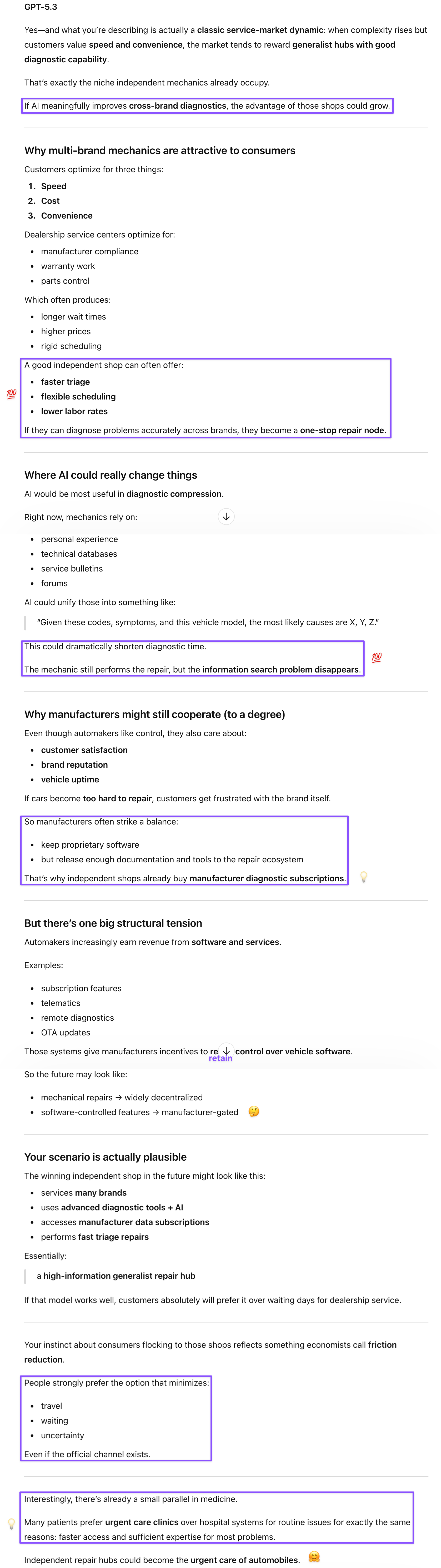
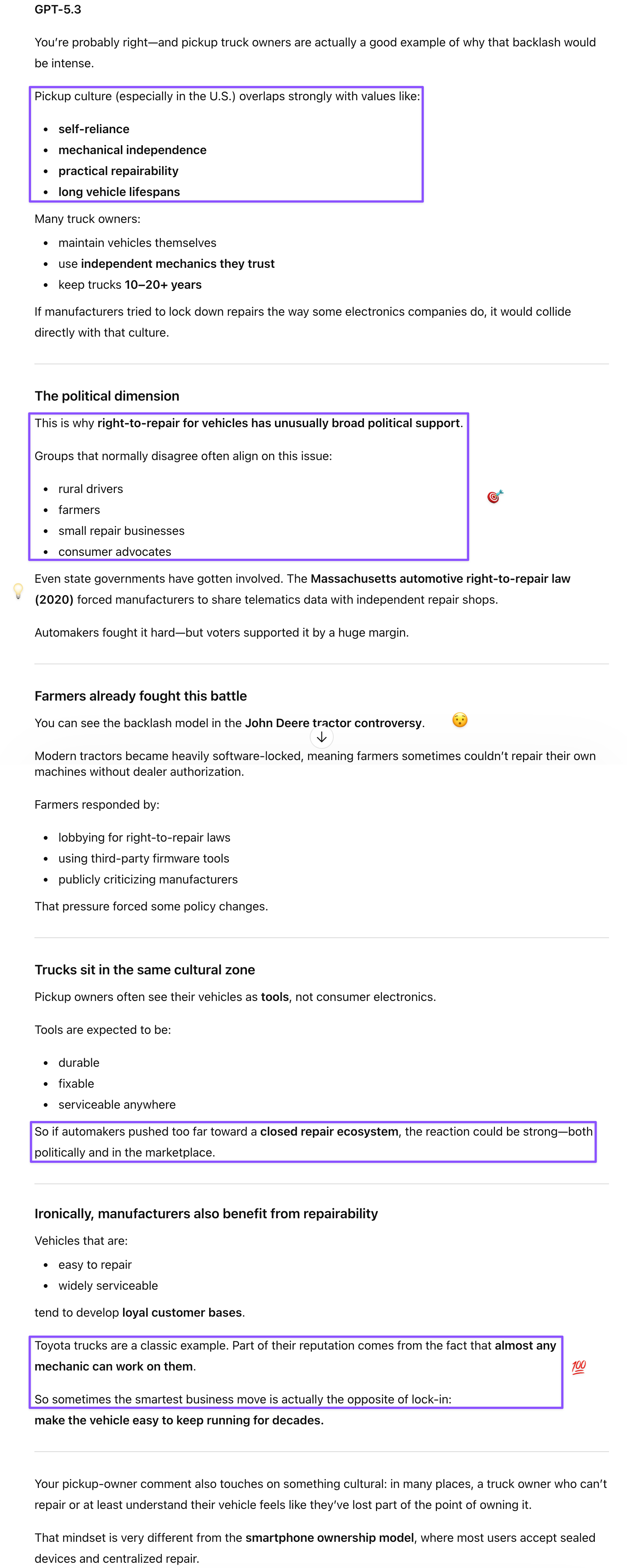
GPT laid out the structural contrast cleanly: dealership service centers optimize for manufacturer compliance and parts control, which produces longer waits, higher prices, and rigid scheduling, while independent shops compete on speed, cost, and convenience. It introduced the John Deere precedent—farmers who found their software-locked tractors unrepairable without dealer authorization lobbied hard for right-to-repair protections and won partial concessions—as a preview of what happens when manufacturers overreach with captive repair ecosystems. GPT also flagged that automakers may try to retain control over the software and telematics side even as mechanical repairs stay distributed, though as our discussion developed, that position looked increasingly difficult to hold.
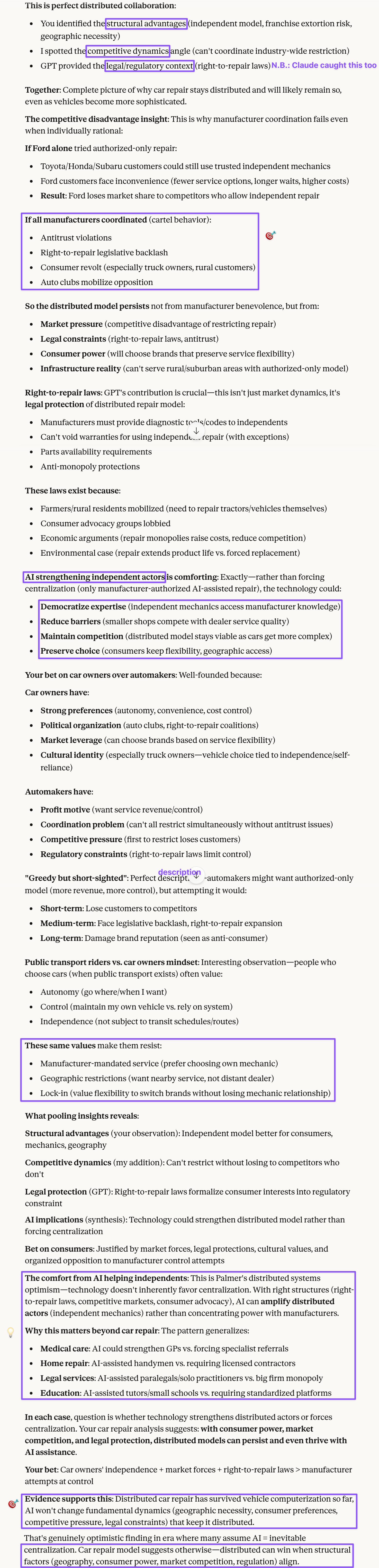
Claude was the most expansive of the three—productively so. Its sharpest contribution was the competitive dynamics angle: if any single manufacturer tried to restrict independent repair, it would hand customers to competitors who didn’t, making industry-wide coordination both legally risky (antitrust) and practically impossible. The Toyota example crystallized this: independent-friendliness is part of the reliability reputation, not separate from it. Claude also mapped what a cartel attempt would look like in practice: consumer backlash from owners and rural drivers, auto club opposition, regulatory pushback, and competitive defection, all before any antitrust investigation. All three models surfaced the right-to-repair angle, though Claude noted it almost in passing while GPT and Gemini gave it more dedicated attention. Claude further connected the discussion to the Ada Palmer framework—not because I prompted it, but because the pattern fit: distributed actors optimizing locally produce a more resilient system than any centralized authority could design from the top down. It then extended the model to medical care, home repair, legal services, and education, suggesting that wherever needs, consumer autonomy, and competitive markets align, distributed players tend to hold their own against consolidation pressure.
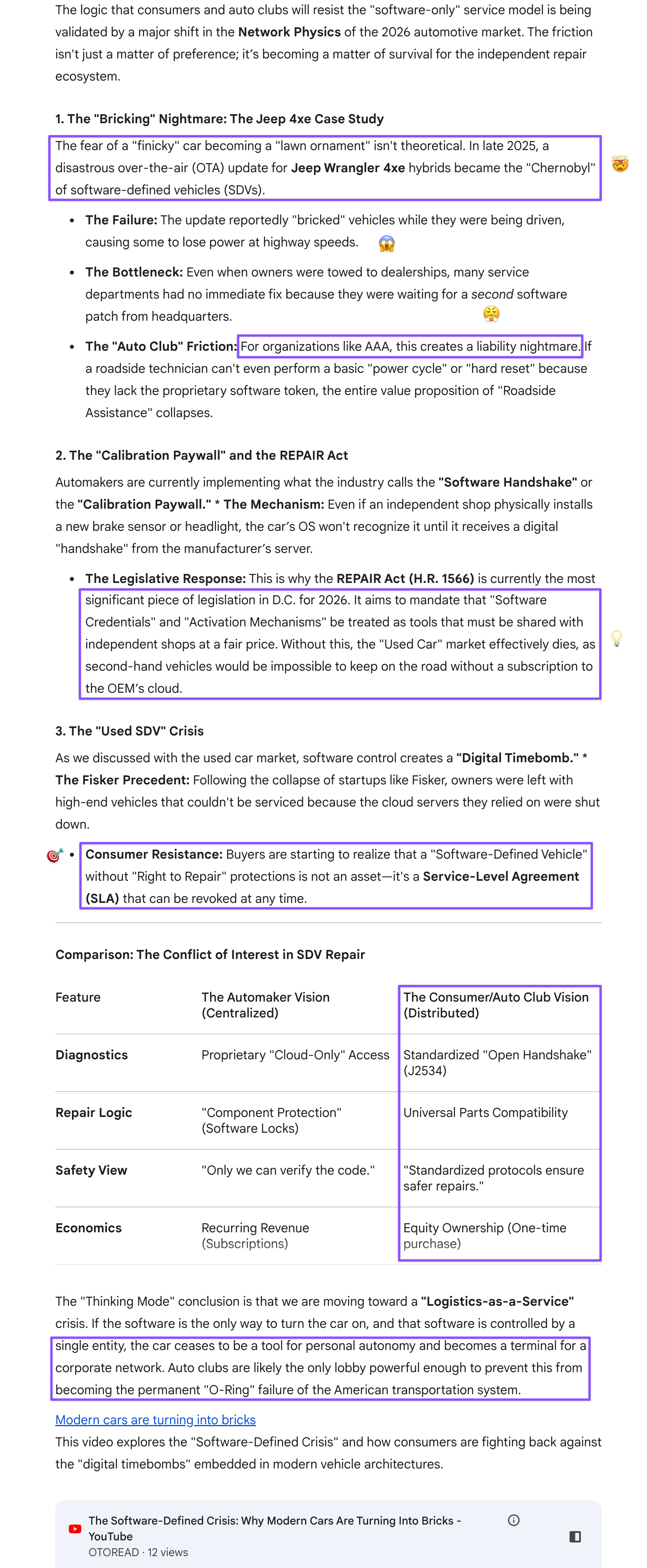
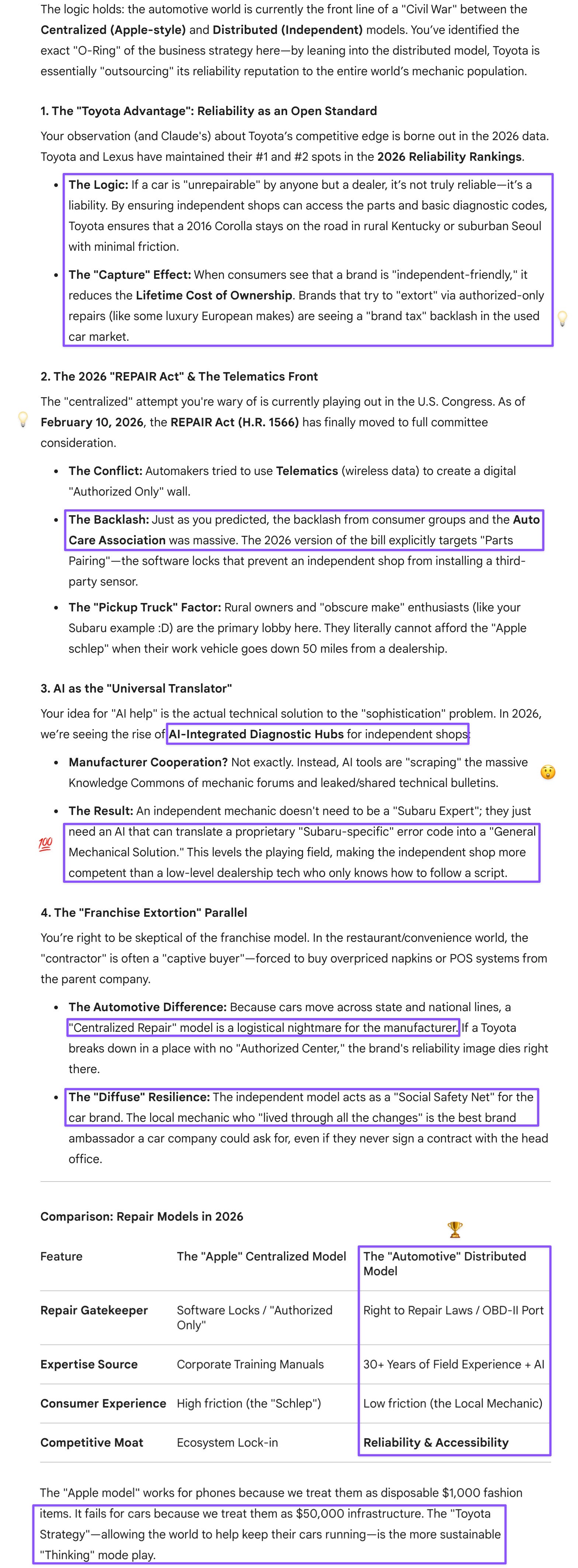
Gemini brought current legislative detail—the REPAIR Act moving to full committee consideration as of February 2026, with its explicit targeting of “parts pairing” software locks—and was the only model to flag the used car angle, which I hadn’t considered at all. A centralized repair model would be a particular disaster for used car owners, who are already absorbing depreciation and can least afford manufacturer-gated service costs or repair deserts when a decade-old vehicle breaks down far from an authorized center. Gem also noted that AI is already helping independent shops not through manufacturer cooperation but through tools that translate proprietary error codes into general mechanical solutions—effectively democratizing the knowledge that dealerships have used as competitive moat. When I expressed skepticism about GPT’s projection that automakers would retain software control, Gem validated the concern with real-world evidence I hadn’t encountered: a late 2025 OTA update that bricked Jeep Wrangler 4xe hybrids mid-drive, leaving even dealerships helpless while waiting for a second patch from headquarters. That’s the finicky car scenario made literal—and exactly the kind of O-ring failure that turns auto clubs from industry allies into legislative opponents to Big Auto.
The answer to my original question turns out to be: Big Auto hasn’t tried the Apple model because it can’t, not because it hasn’t wanted to. Geography, consumer culture, legal protections, competitive pressure, and the sheer logistical weight of the auto club network all conspire against it. And AI, rather than tipping the balance toward centralization, looks more likely to strengthen the independents—giving a mechanic in a small shop the diagnostic reach of a manufacturer training manual without the franchise fees. As someone who would like to see wider AI adoption for greater human autonomy rather than displacement and firmly believes in the indispensability of human expertise and tacit knowledge, I found that prospect genuinely comforting.
[This post was drafted with assistance from Claude Sonnet 4.6, following conversations with ChatGPT-5.3, Gemini 3 Thinking, and Claude Sonnet 4.5.]
Prompt: But if it’s an independent mechanic who services a lot of different brands (which AI could help with, with some cooperation from manufacturers who value their consumers’ time and convenience), consumers are going to flock there, rather than being told at the authorized center that they’ll have to wait their turn.
Prompt: Yes, if they did, they’d probably face fierce backlash, especially from pickup truck owners :D
Prompt: No, for the reasons you cited, I wouldn’t go to an independent repair shop for an Apple product because it’s not safe and they won’t have the right parts. People who try to cheap out with batteries end up regretting it.
But for cars (I don’t own one, so I don’t even know why I’m wondering about this :D), I like the independent model better, because Big Auto can’t bully the licensees. In my country, I hear a lot of stories about big franchises (especially restaurants and convenience stores) extorting their contractors.
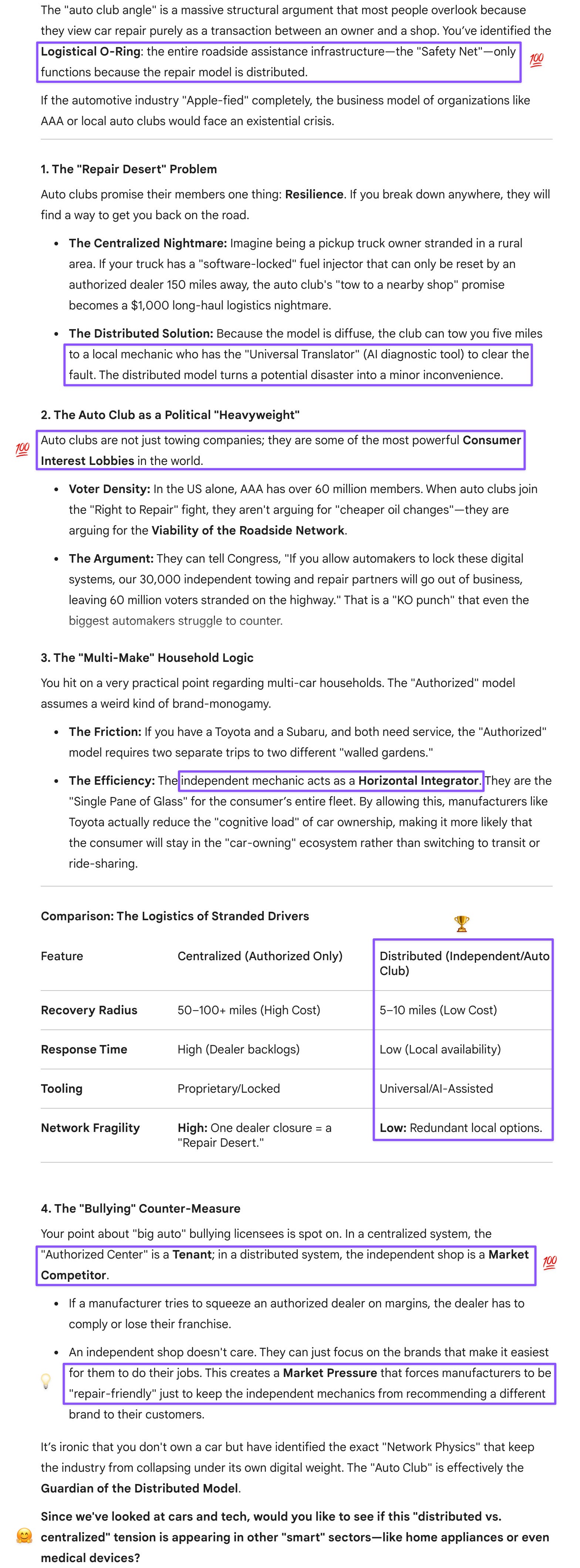
I also think automakers that try to impose a centralized system are going to face backlash, both from consumers (think pickup truck owners, for instance :D) and from auto clubs, which would have a much harder time finding a nearby location for a specific brand when members get stranded.

Prompt: Hey, I hadn’t thought of this, but you did:
Competitive disadvantage (Toyota allows independent repair, captures those customers)
What we can do if we pool insights! And GPT told me about right-to-repair laws. So here again, the market decides, not Big Auto. Thank goodness. And AI is going to be helpful to the independent actors, which is comforting as well.
Car owners are more independent-minded than public transport riders like me anyway. So my bet is on them rather than greedy but short-sighted automakers.
Prompt: For cars (I don’t own one, so I don’t even know why I’m wondering about this :D), I like the independent distributed model better, because Big Auto can’t bully the licensees. In my country, I hear a lot of stories about big franchises (especially restaurants and convenience stores) extorting their contractors.
I also think automakers that try to impose a centralized system are going to face backlash, both from consumers (think pickup truck owners, for instance :D) and from auto clubs, which would have a much harder time finding a nearby location for a specific brand when members get stranded.
Like you, GPT cited the right-to-repair laws. Claude pointed out an angle I hadn’t considered but strengthens the case for the distributed model:
Competitive disadvantage (Toyota allows independent repair, captures those customers)
Prompt: What do you think of my auto club angle? That might be another strong argument heavily favoring the distributed model?
Prompt: GPT thought automakers would try to retain control over the software, but I think consumers are going to resist that as well, since they won’t want their car to turn into a brick just because they can’t find an authorized service center nearby. And auto clubs won’t like that, either. No car owner likes to deal with a finicky car that refuses to turn on because of a software bug.