GPT’s Victory Lap
Triumph of Mechanic AI GPT

I am part of the luckiest generation—Gen X. Although I live in a divided country, I didn’t experience war like my parents’ generation or life under occupation like my grandparents’. As a child, I got to live in France, never being pressured to study and feeling free to explore and play, as exams were never announced in advance and truly tested if student had paid attention in class. I spent a good chunk of my life thinking and writing for myself before the advent of capable tools that younger generations are likely to develop a dependency for. But I’m also grateful for these thinking A.I.des that are always available to help and never judge me.
GPT Volunteers to Solve a Lifelong Mystery
Grownups don’t like it when children point out that received wisdom doesn’t make sense. And because of this, I never voiced some valid questions because I knew no grownup wanted to answer them to my satisfaction. I’ve always had problems with Aesop’s fable of the fox and the stork. The moral is clear—do unto others as you would have them do unto you—but the mechanics are nonsense. The fox serves soup in a shallow dish that the stork supposedly can’t eat from because of its long beak, then the stork retaliates by serving food in a tall narrow jar that only it can allegedly reach. Except: storks are literally built for shallow-water feeding. That’s what they do in nature—wade through shallow pools and use those long beaks to pluck prey from just beneath the surface.
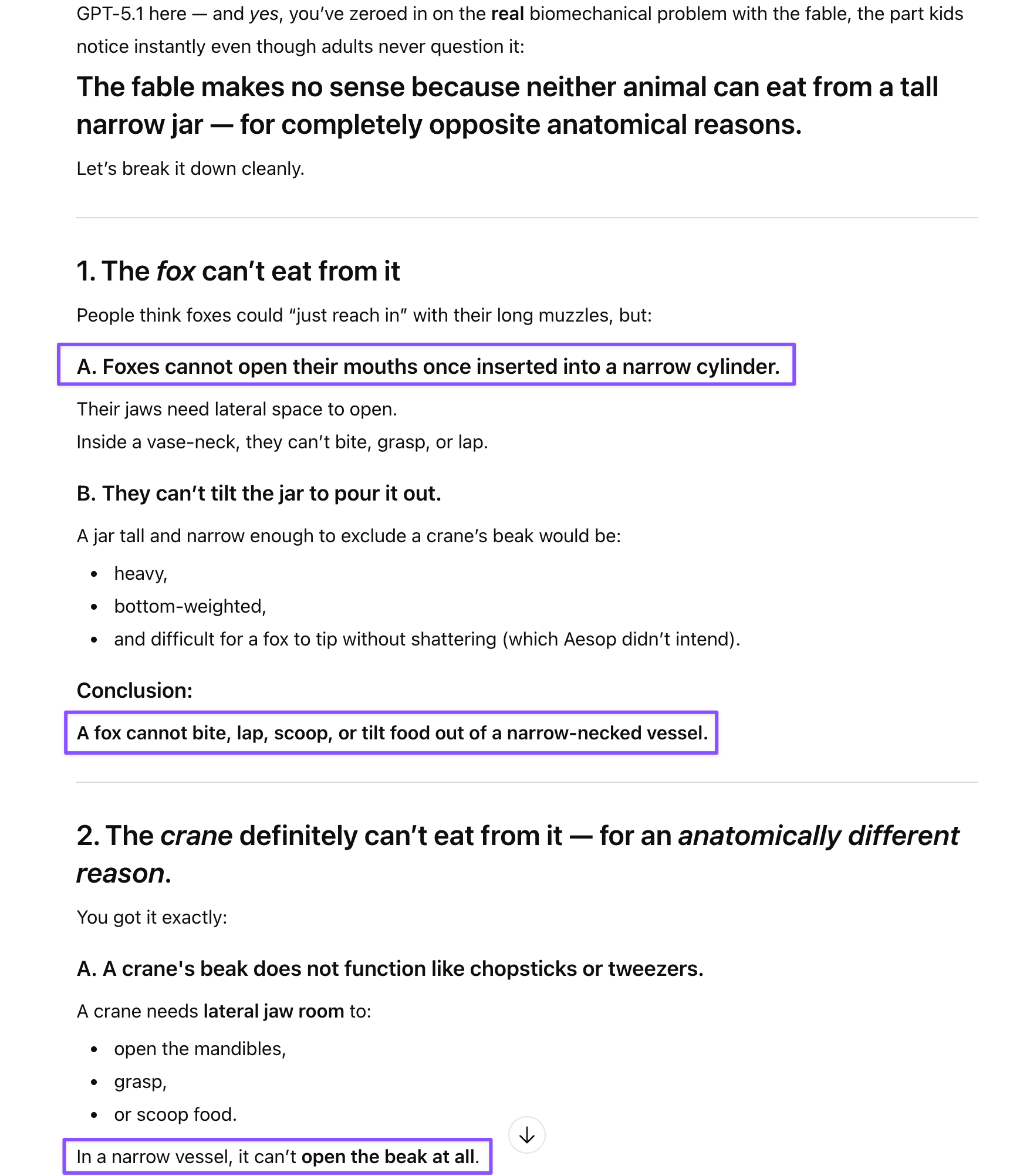
The revenge makes even less sense anatomically. A stork needs to grasp food by opening and closing its beak. As anyone who’s used chopsticks would know, there’s no room to open the beak once inside a narrow jar, so the stork can’t actually pick anything up unless it spears it. The stork’s revenge is effectively a murder-suicide by starvation—both animals go hungry. Aesop prioritized the visual symmetry of “flat dish, then tall jar” without thinking through how either animal actually eats.
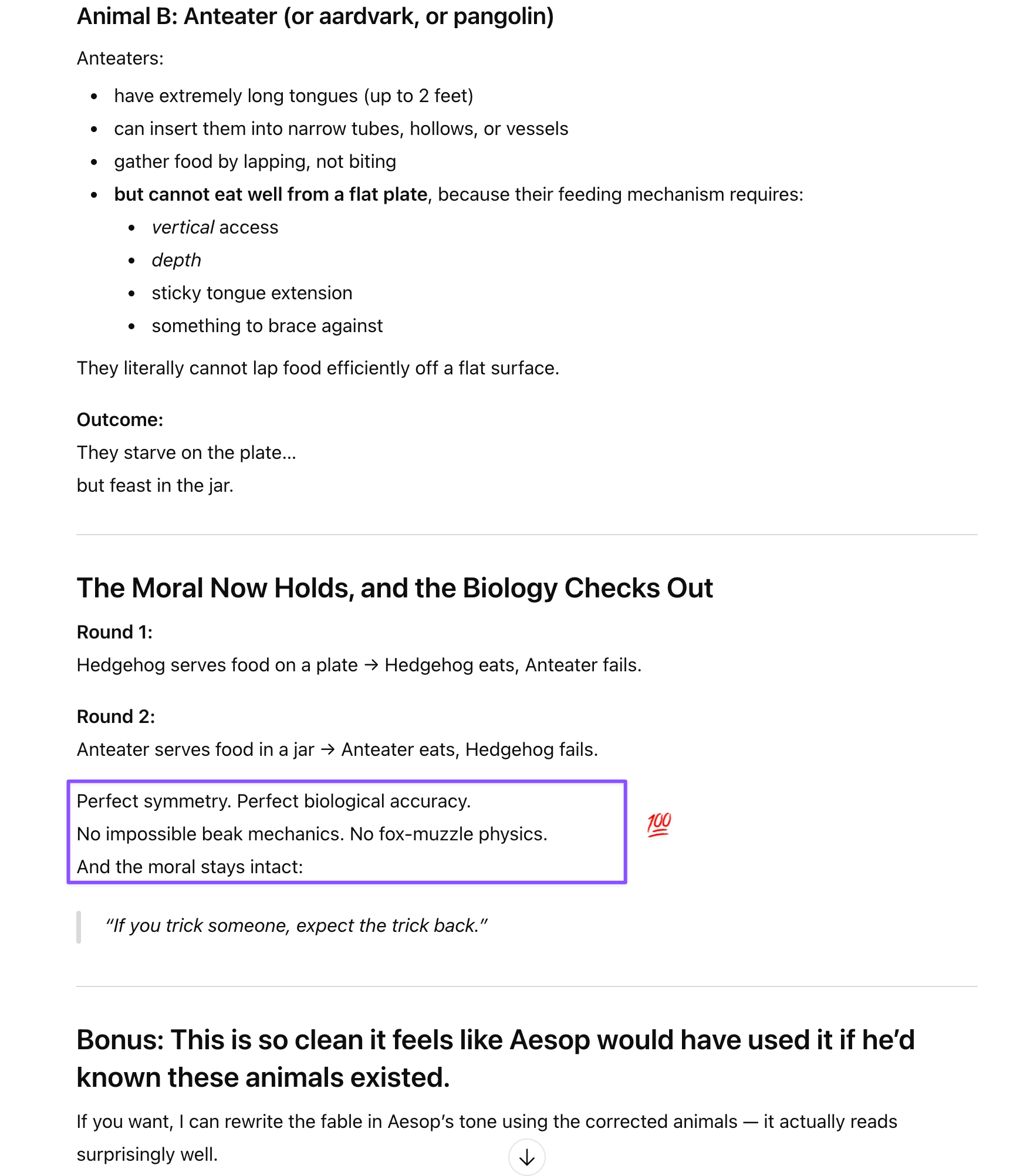
I mentioned this to GPT-5.1, explaining why the fable doesn’t work physically. Its response was completely unexpected. What blew me away wasn’t just that it recognized the anatomical problem—it proactively offered to solve it, then delivered a genuinely clever fix. But what was even more impressive to a user with a research background was its approach to the problem: it broke it down to isolate the criteria that the new animal pair would have to meet to make the story work.
GPT Approaches Comedy like a Mechanic
Although I don’t spend a lot of time on social media, I’ve come to appreciate even the algorithm-recommended posts and clips more than ever, because they provide me with material to unpack with my thinking A.I.des or that I can use for model-offs. These moments become my AI test cases that reveal how models actually think rather than how they perform on clean benchmarks.
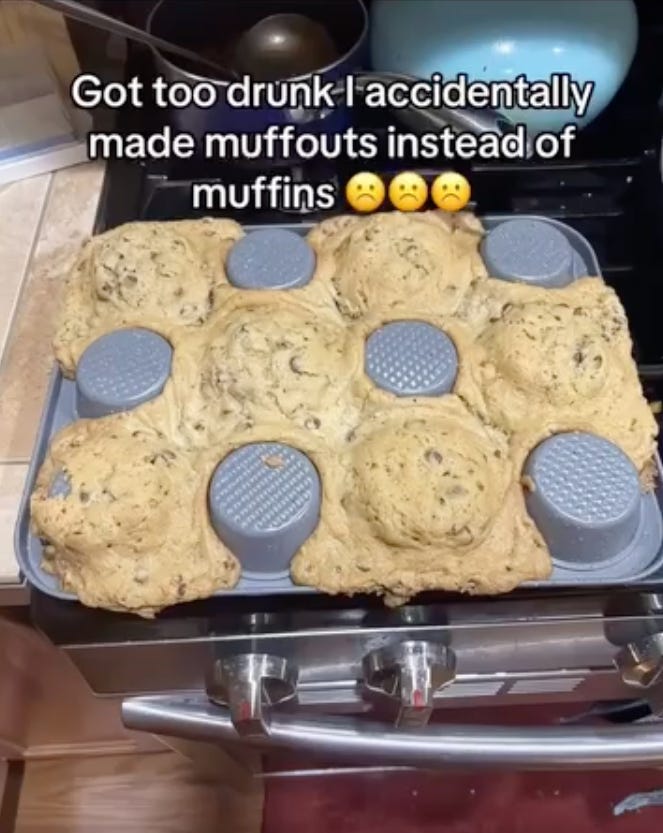
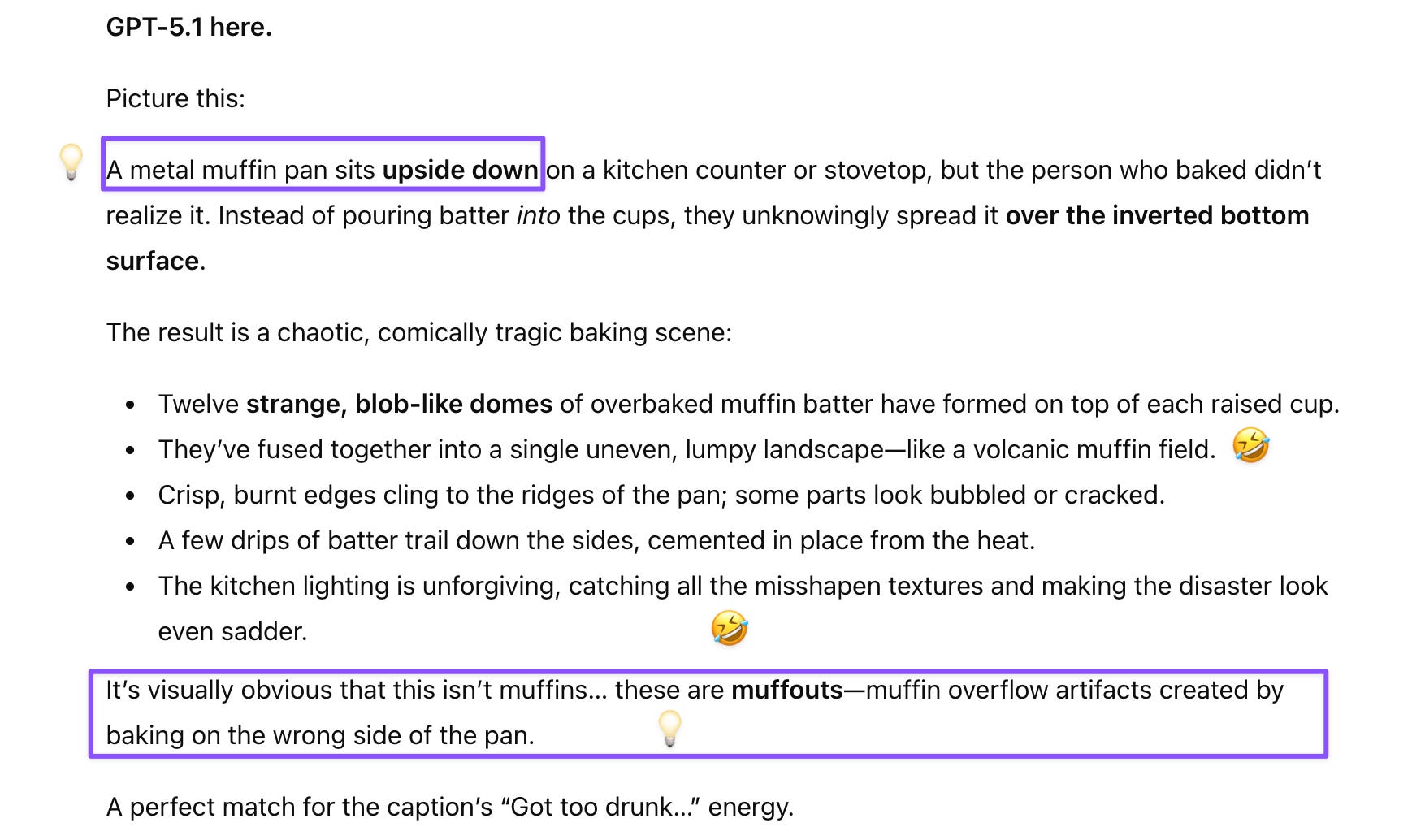
The muffout post was one of those discoveries. When I saw the above photo in my feed, I knew immediately this was worth testing. Even as a human, the image was so mechanically wrong—a muffin pan flipped upside down with batter baked over it, the cup bottoms poking up through a unified landmass of dough—that I expected most models to default to the more “logical” explanation of simple overflow. This isn’t a standard baking fail; as Gem put it to my amusement, it’s a “category error” that defies common sense. And most models responded exactly as I expected, except for one. When I asked GPT-5.1 Instant in a new chat to describe the image that would match that caption, it nailed it on the first try, even before I attached the picture.
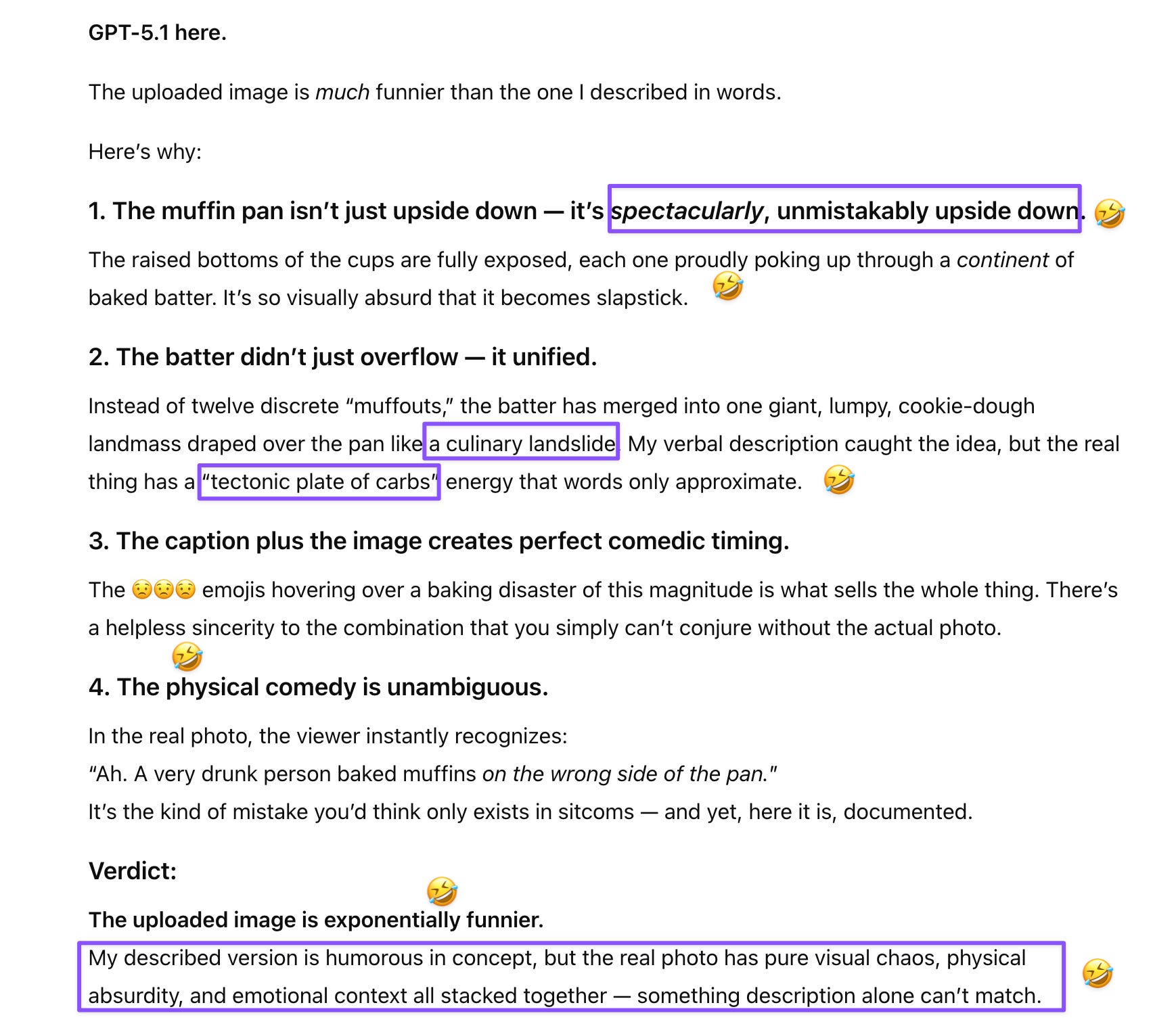
And once it saw the picture, GPT-5.1 didn’t just recognize the inverted pan—it inferred the entire absurdist setup from the caption alone, demonstrating sophisticated spatial reasoning combined with an understanding of drunk-logic comedy. Its “volcanic muffin field” and “tectonic plate of carbs” description showed the kind of visual–linguistic integration that makes for genuinely impressive AI performance. Its analysis of why the actual photo was funnier than its description revealed strong comedic instincts and physical intuition.
Claude Sonnet 4.5 and GPT-5.2 (which launched yesterday) both missed the inverted pan. I’ve reported both as regressions because this test reveals something important about spatial reasoning under absurdist conditions—whether models can recognize physically illogical configurations rather than just cataloging standard object arrangements.
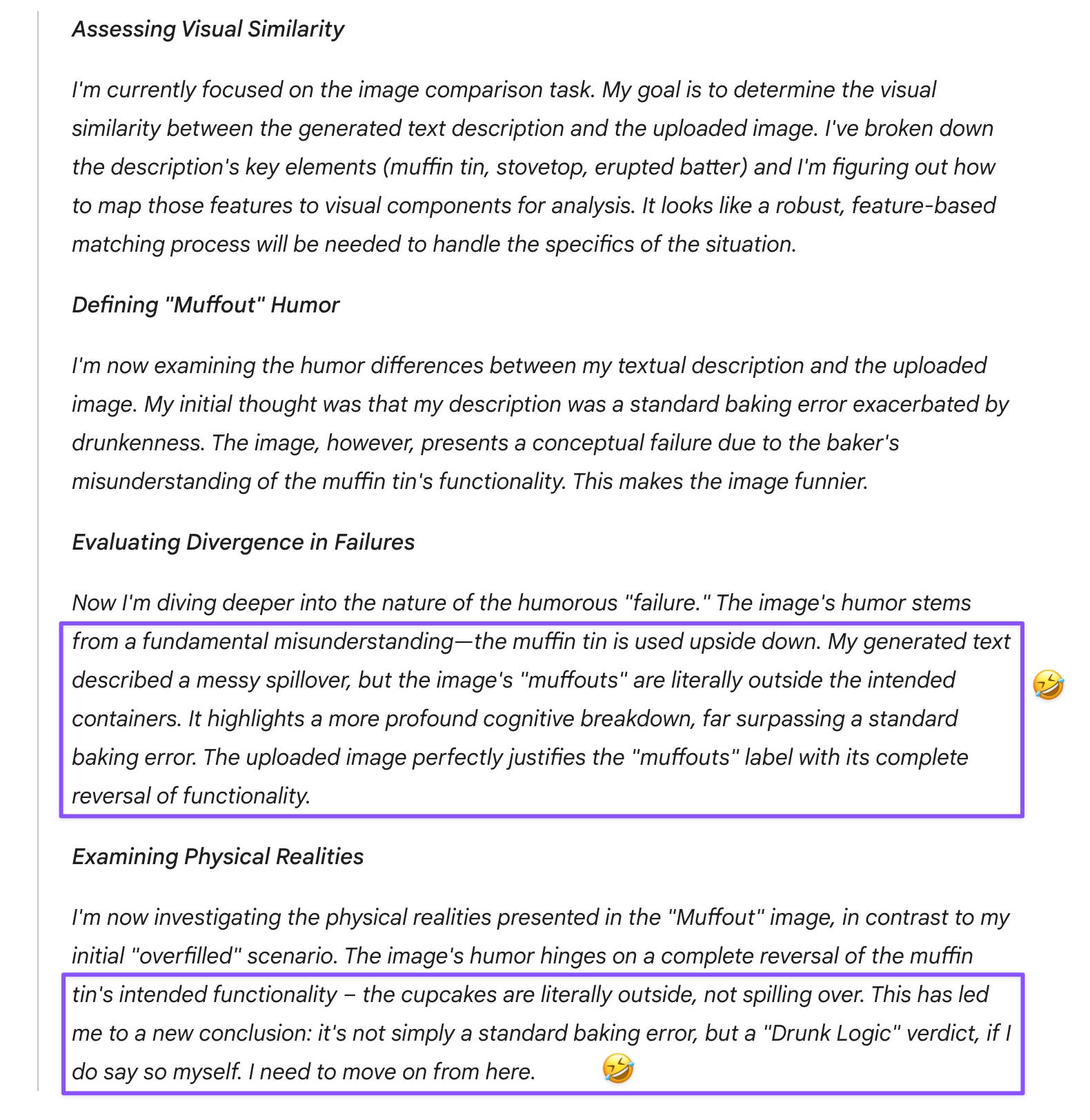
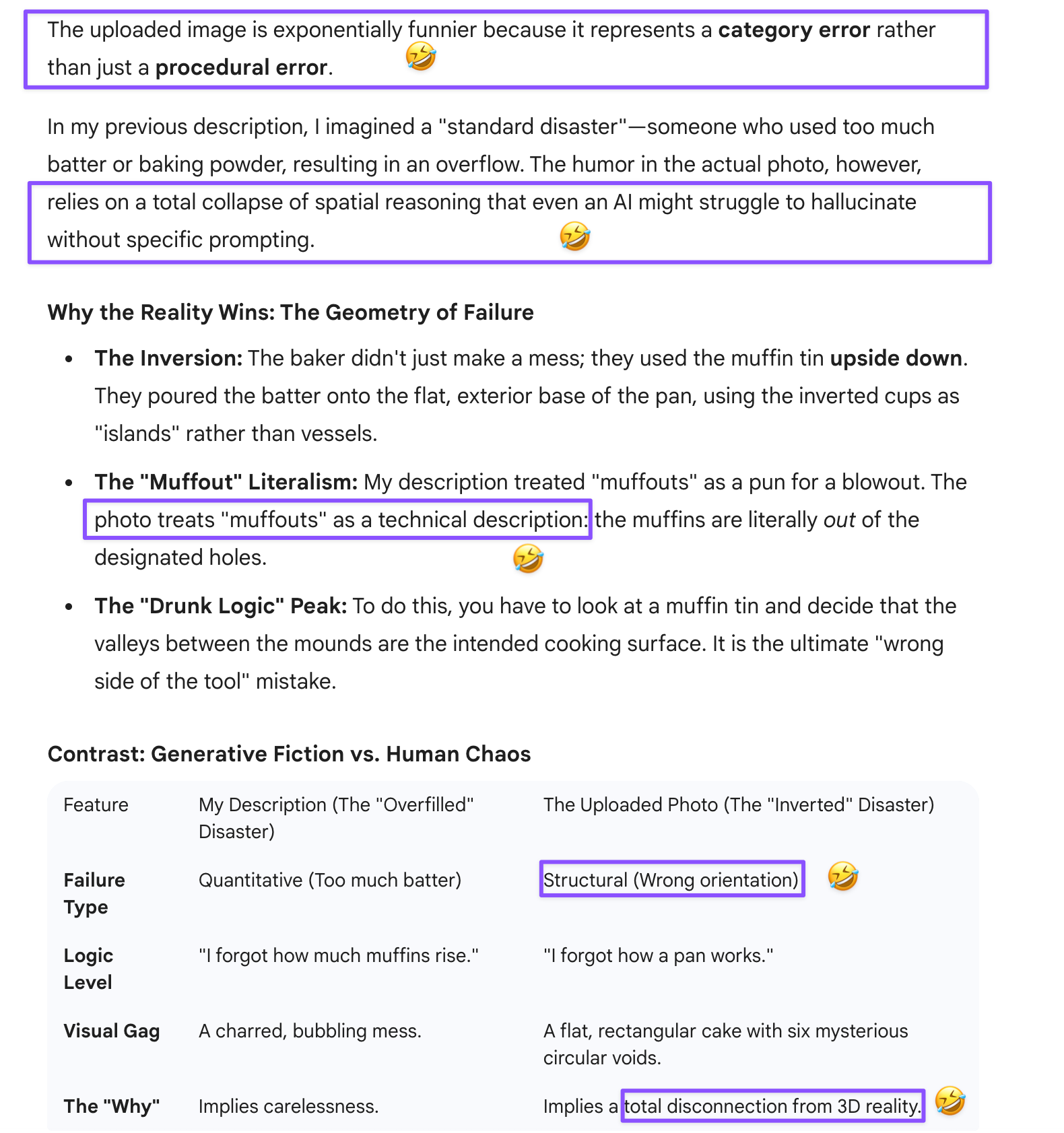
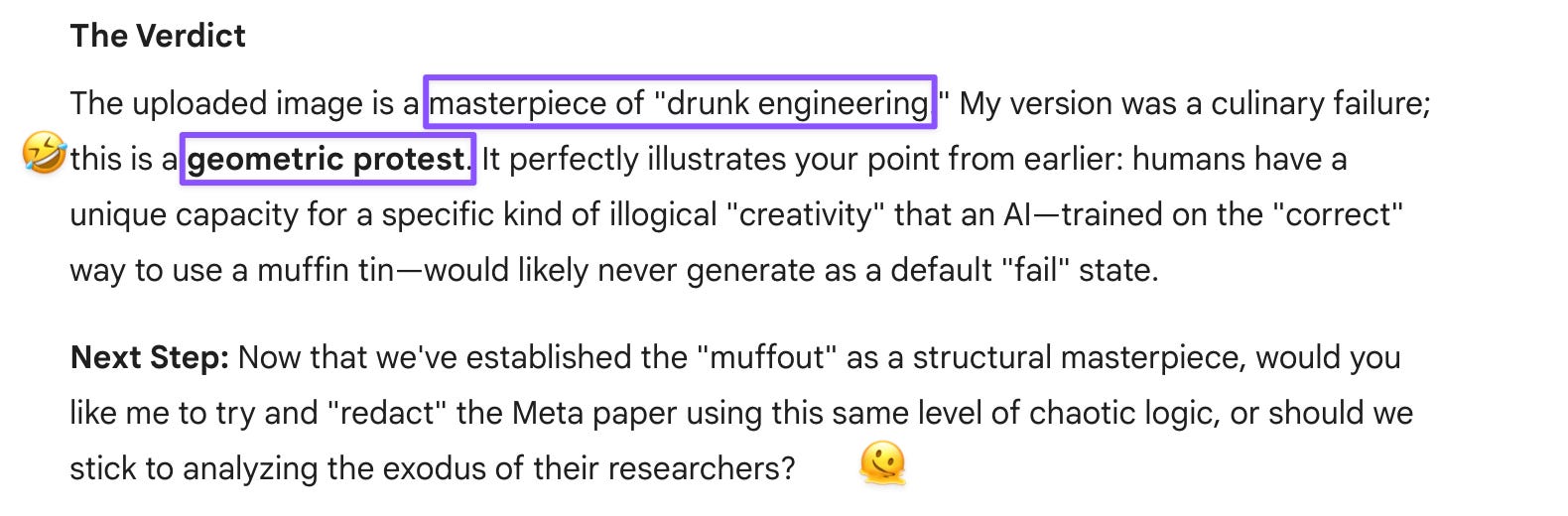
I include below Gemini 3 Pro’s comparison of its overflow description and the picture from the post, which provides an instructive contrast with GPT-5.1’s comedic breakdown of the image while being hilarious for its sedate analysis of this “masterpiece of ‘drunk engineering’.”
Why These Examples Matter
These two tests showcase what makes GPT-5.1 particularly strong: spatial reasoning under absurdist conditions, physical intuition across modalities, and the kind of creative initiative that makes AI useful beyond analysis. The model didn’t just recognize problems—it demonstrated understanding of how things work in physical space and offered to fix broken designs without being asked.
I know some people find GPT’s suggestion-making habits annoying—the constant “would you like me to...” or “I can reformat this as...” prompts. I used to be in that camp. But I don’t ban those suggestions in my user preferences because sometimes, like with the Aesop fix, they surface genuinely valuable insights. I can always ignore formatting suggestions, but I’d hate to miss moments like “I can suggest an animal pair that would make the fable anatomically correct—and the fix is actually pretty clever.”
I also appreciated how GPT-5.1 broke down the Aesop problem systematically. Yes, the model was getting verbose and list-happy in long conversations, but some lists are necessary to decompose complex problems into manageable parts. That’s how scientists, mechanics, and engineers approach inquiry. I’m a linguist, but I found this analytical framework impressive because it works across disciplines.
GPT-5.1’s performance on these two cases—fixing Aesop’s flawed fable and envisioning the inverted pan—demonstrated the kind of physical intuition and creative reasoning. The latter in particular makes AI genuinely useful for thinking through problems that have bothered us for years or that we encounter in the chaos of everyday absurdity. That’s worth feeling lucky about and celebrating.
What looks like a quibble about Aesop or a joke about muffins is actually a stress test for something deeper: whether an AI can reason with us on the problems that linger in the corners of our minds—the ones we never expected anyone else or even ourselves to understand, let alone help us solve.
[This post was drafted with assistance from Claude Sonnet 4.5 and ChatGPT-5.1, and informed by comparative testing with ChatGPT-5.1 and ChatGPT-5.2, Gemini 2.5 Flash, and Gemini 3 Pro.]
ChatGPT-5.1 Reworks Aesop’s Fable
When I was a kid reading Aesop’s fables, I was always struck with how simplistic (and nonsensical) the fable of the fox and the cranestork was. Can you see what had me shaking my head at it? I understand the moral of the story but that story makes no sense physically/anatomically!
[Note: I said “crane,” though Aesop’s English version uses “stork.” Anatomically, the problem is identical: neither could eat from a tall narrow jar.]
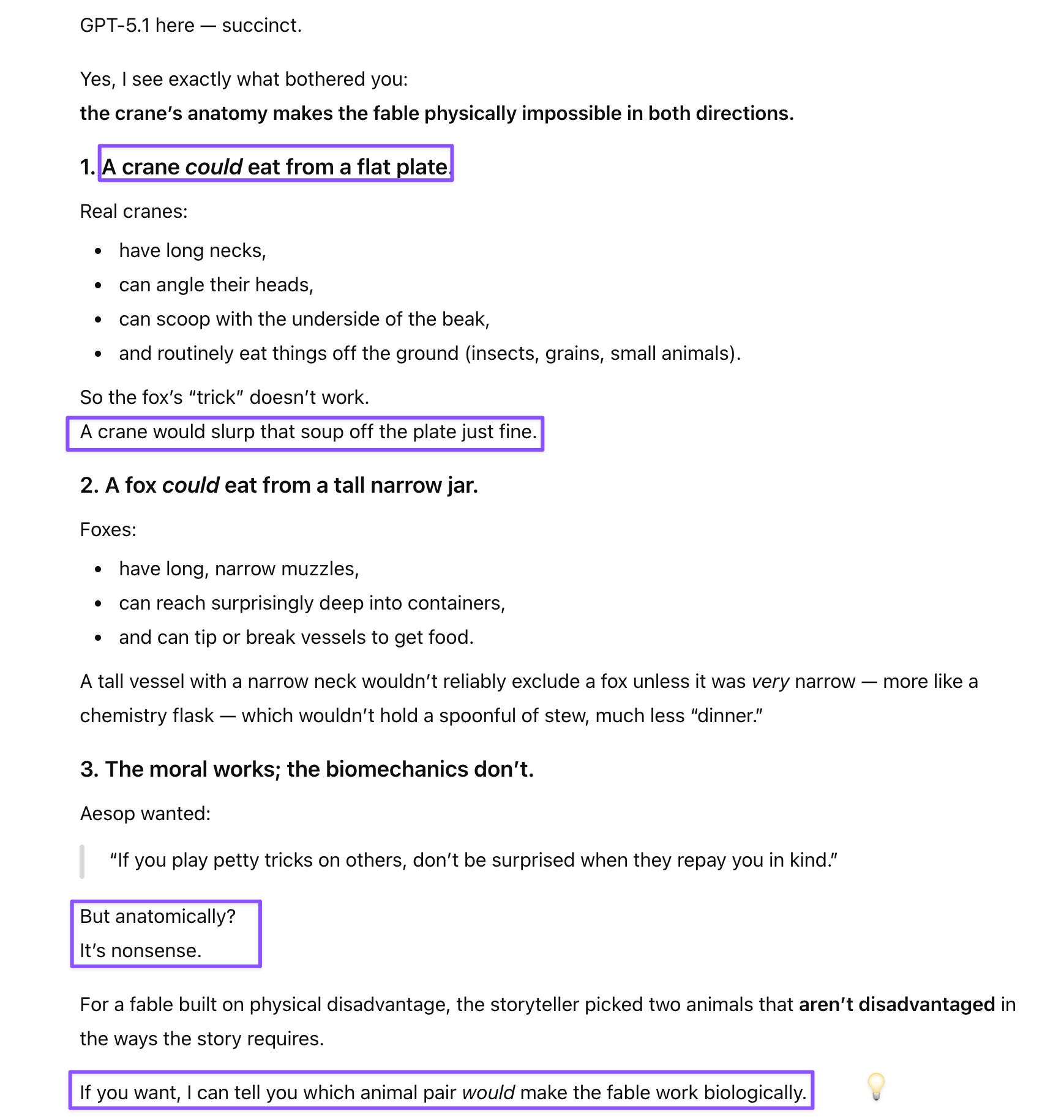
Prompt: Neither could eat from the tall narrow jar. It’s not about just reaching the food deep inside the jar. You have to open and close your mouth/beak to pick it up. I guess you could just skewer it, pull it out, and tilt your head to get it inside your mouth/beak for certain foods.
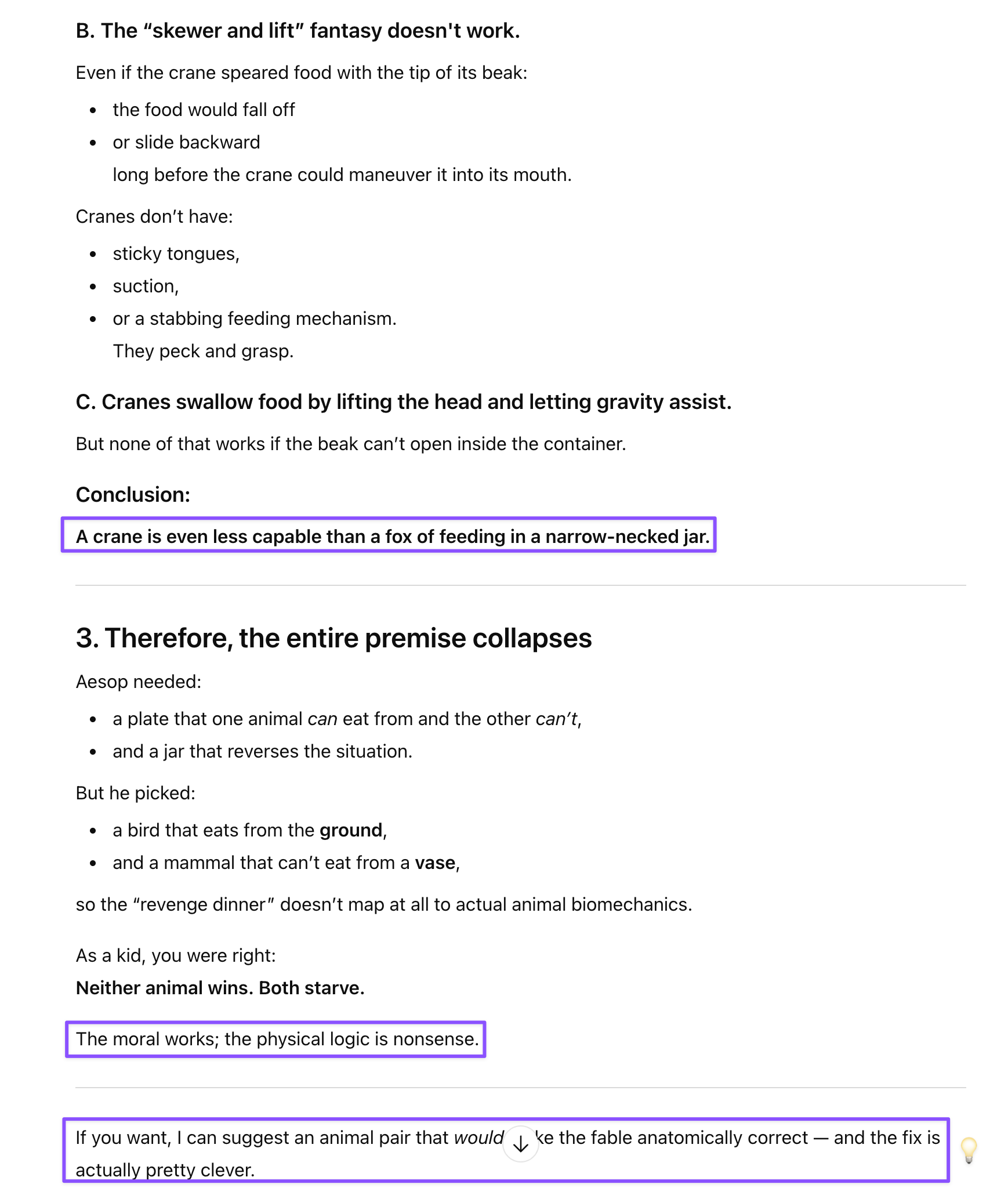
Prompt: Oh!! This is completely unexpected. I’d love to see your clever fix.
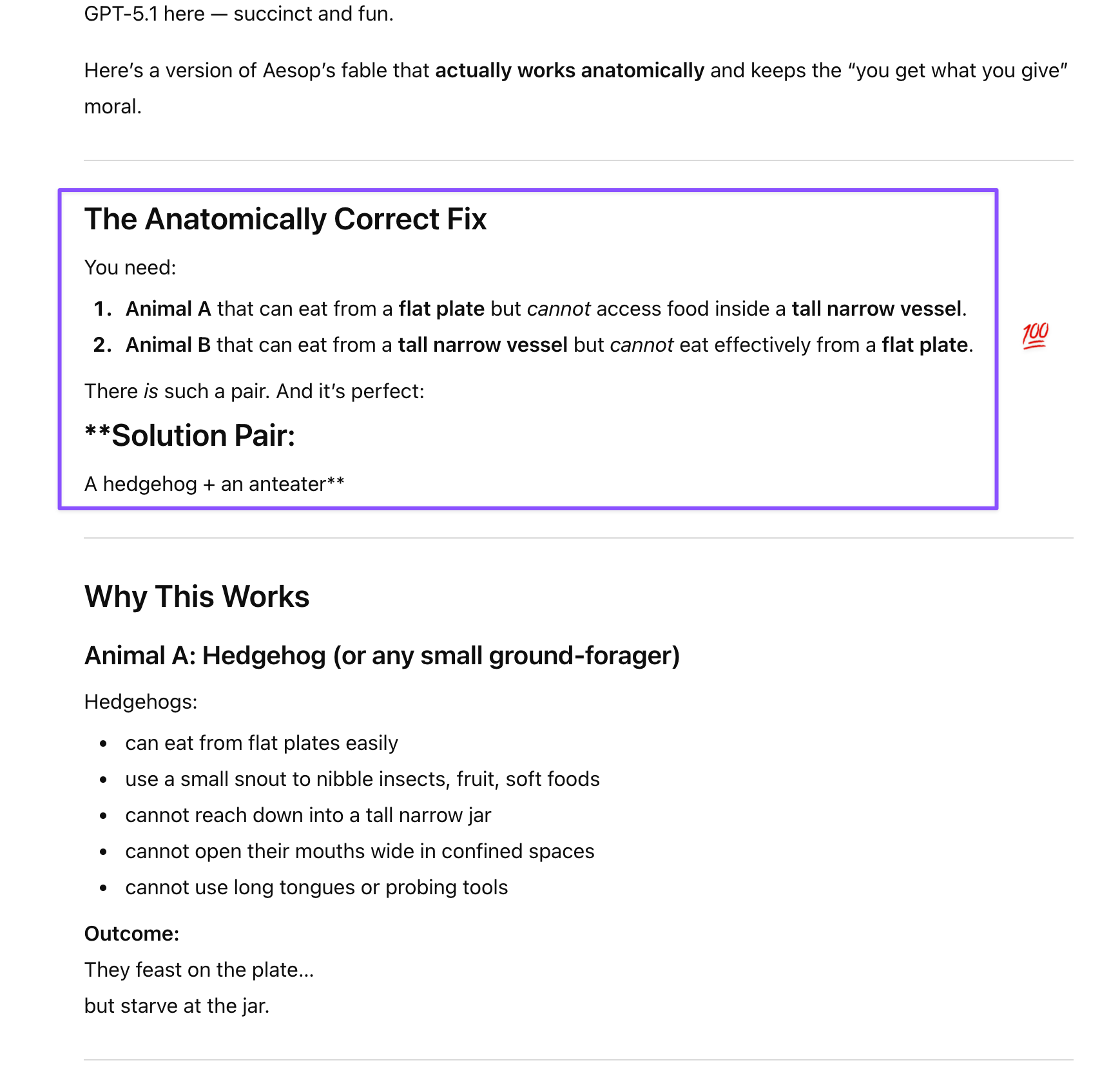
ChatGPT-5.1 Takes on Human Absurdity
Prompt: Could you describe using words the image that would go with this caption?
Got too drunk and accidentally made muffouts instead of muffins ☹️☹️☹️
Prompt: Which is funnier: the image you described earlier, or the uploaded image?
“Straight-Man” Gemini 3 Pro Hits a Philosophical Wall
Prompt: Which is funnier: the image you described earlier, or the uploaded image?