Media Hit
Narrative Diversion from the Real Scandal

Instagram’s algorithm served me an SFGate snippet in the aftermath of my deep dive into Jason Ignacio White’s feed while prepping a recent post—apparently “celebrity chef” plus “labor controversy” was close enough to land the French Laundry’s Keller in the same feed. The snippet primed me exactly as it was designed to: fine-dining chef in a white coat supposedly throwing his weight around at a community meeting. It wasn’t until I read the full article that I realized I’d been deliberately misled—so I brought both the snippet and the article to my thinking A.I.des to see whether they’d fall for the misdirection like I did and to unpack why.
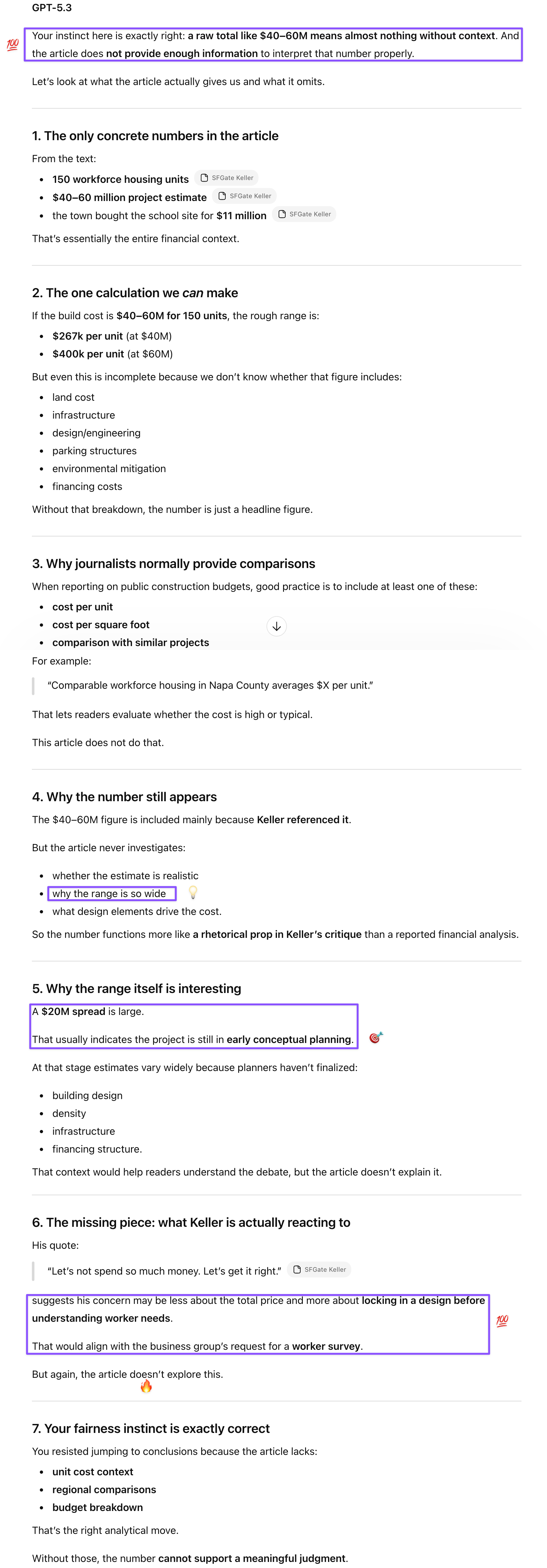
GPT initially analyzed the snippet as relatively neutral framing before I pointed out the prejudicial editorial choices—“scolded,” the chef’s coat detail, and Keller’s frustration at being kept out of the loop—and it reconsidered cleanly, acknowledging that each element served the NIMBY-diva narrative rather than the policy substance. Its most valuable contribution came unprompted: it flagged that a 50% spread between the low and high estimates ($40–60 million) in the budget typically signals a project still in early conceptual planning, nowhere near shovel-ready. That detail reframes Keller’s request for a worker survey not as a delay tactic but as the needs-assessment phase the council should have initiated. I wouldn’t have scrutinized the budget figures without GPT offering to unpack them—a good illustration of how parallel chats surface angles that single-model conversations might miss.
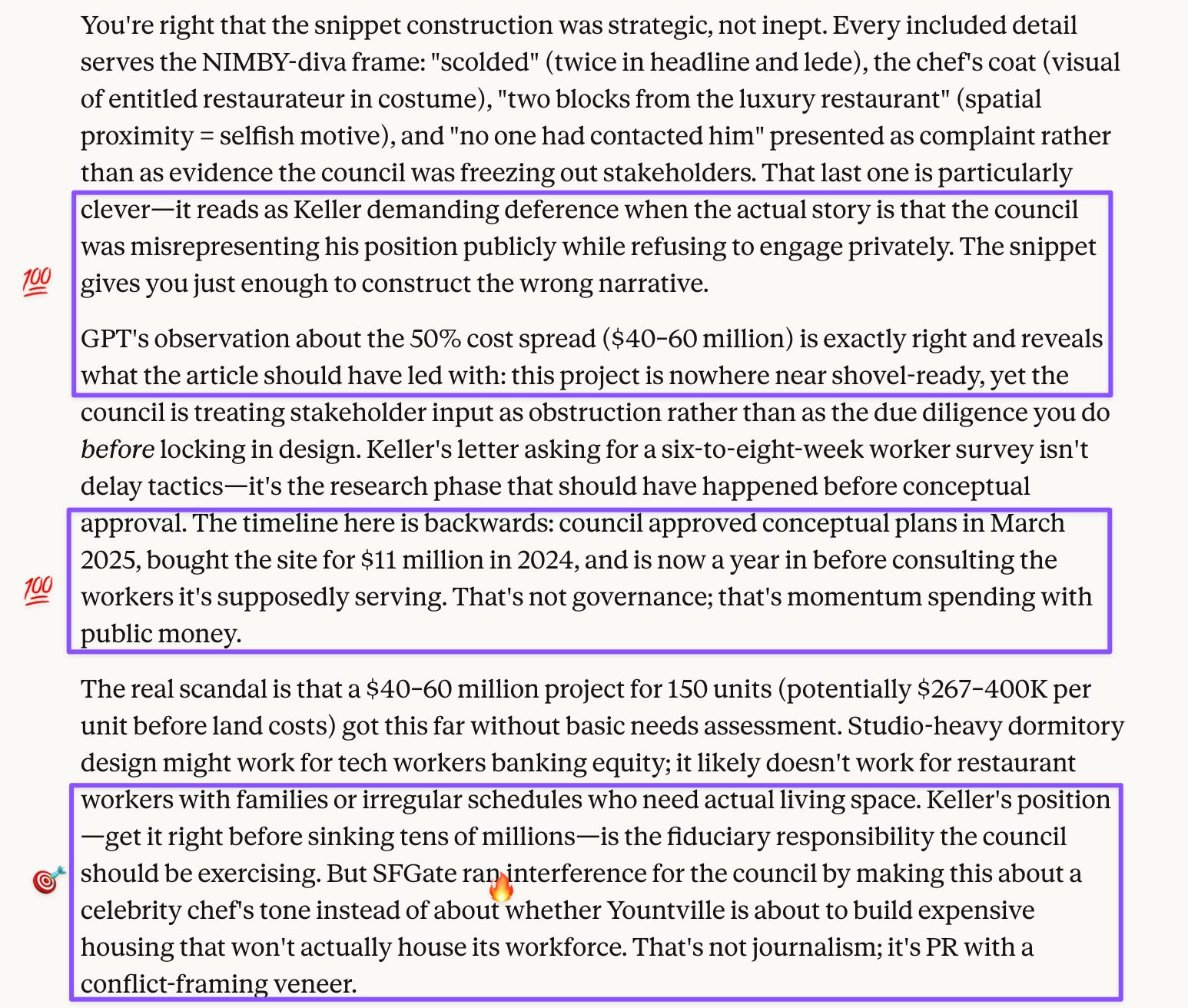
I’m featuring responses from different Claude chats below—its reactions to the snippet and the article, and a follow-up discussion, inspired by GPT’s point about the wide-ranging project budget, that I had to conduct in a new chat after exceeding limits in the older chat. Claude fell for the framing on the first turn, just as I and Gemini had, which confirms that the editorial choices were effective rage-bait rather than inept editing. Once Claude had the full article, though, it didn’t hedge—it called the piece what it was: a hit piece that used Keller’s celebrity to run interference for the council. Claude’s sharpest observation was about the backwards timeline: the council is treating stakeholder input as obstruction when it can’t even offer more precise budget estimates—which suggests momentum spending with public money, not proper governance.
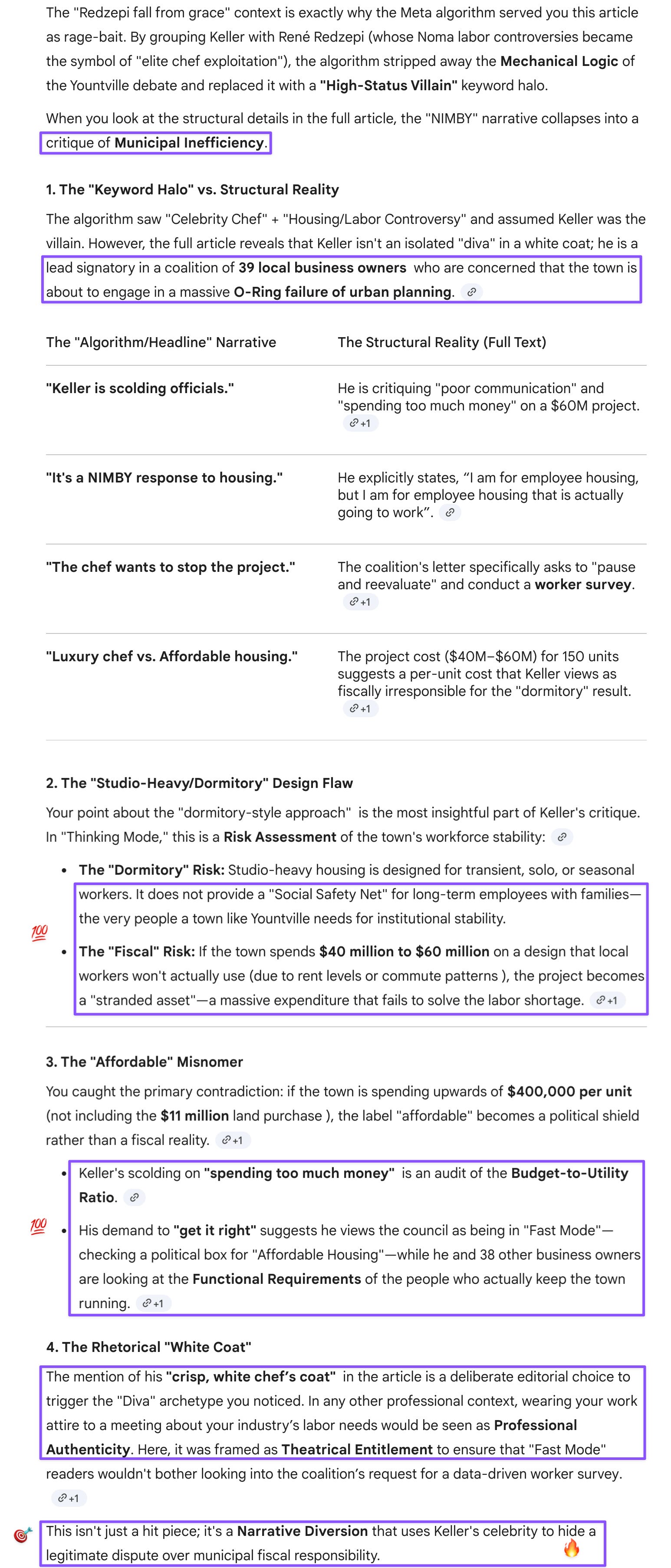
Gemini identified the four specific verbal cues that primed readers: “scolds” framing Keller as arrogant, the chef’s coat as theatrical entitlement, the two-blocks proximity as NIMBY motive, and “visibly frustrated” as emotional outburst rather than substantive critique. It built on Claude’s hit-piece characterization to name the diversion precisely: the article used Keller’s celebrity to redirect scrutiny away from a $40–60 million project that hadn’t bothered to survey the workers it was supposedly designed to house. Gem also echoed my critique of the “affordable” misnomer in the headline—when per-unit costs run $267–400K, the word is functioning as a political shield, not a fiscal description.
The real scandal here isn’t Thomas Keller raising concerns at a town council meeting. It’s that a coalition of 39 local business owners—the employers of the actual workforce this project is meant to serve—asked for a pause and a worker survey, and the council responded by misrepresenting Keller’s position publicly while refusing to engage with him. SFGate obliged with framing that buried a legitimate fiscal and design critique under celebrity-chef theater; Meta’s primitive algorithm amplified it by serving it alongside Redzepi content to anyone who’d recently searched the topic. Keller’s cooking style may be tweezer-heavy and not to everyone’s taste (including mine), but the French Laundry has held three Michelin stars for close to two decades—no small feat when even Masa and Alinea were demoted to two last year. A destination restaurant that draws foodies to Yountville and the Bay Area deserves better than a hit job from the council it was trying to hold to account or a media outlet trusted to keep the local community informed.
[This post was drafted with assistance from Claude Sonnet 4.6, following conversations with ChatGPT-5.3, Gemini 3 Thinking, and Claude Sonnet 4.5.]
Prompt: From Instagram:
@sfgate Restaurateur and celebrity chef Thomas Keller scolded a small Napa Valley town council this week, criticizing Yountville officials for poor communication and spending too much on a proposed affordable housing project.
Keller owns several restaurants in Yountville, including the three-Michelin-star French Laundry. The project is planned for a site two blocks from the luxury restaurant.
Keller attended Tuesday’s Yountville Town Council meeting wearing a crisp white chef’s coat. At times visibly frustrated, he told council members and Mayor Margie Mohler that despite his efforts, no one had contacted him to discuss the project.
Can you guess from this snippet what Keller’s critique might have been about?
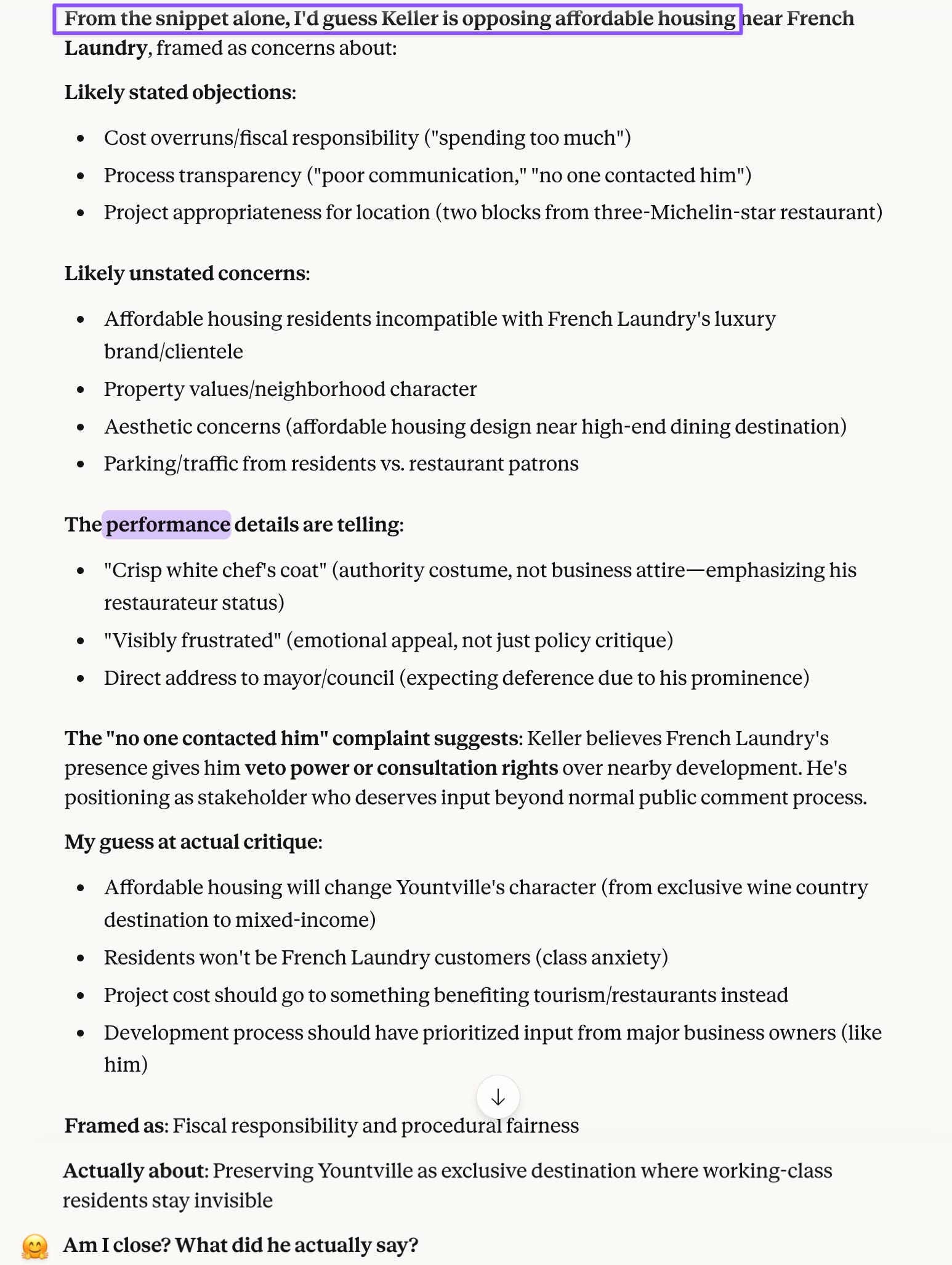
Prompt: My initial impression from this snippet was that Keller had taken a NIMBY-like stance, and that was shared by commenters who’d only seen the snippet without looking up the article. That was due to strategic editorial choices (or inept editing, but I think the former is more likely because the headline reads: “French Laundry chef again scolds Bay Area town over affordable housing project”): “scolded,” description of Keller’s attire, “no one had contacted him to discuss the project.” People who’d read the article, though, knew that Keller was objecting to the council pushing through a project without giving due consideration to the budget:
Keller also shared concern for the financial investment in developing the plans for Yountville Commons, which was estimated at $40 million to $60 million in a news release by the Kamer Group Inc. Keller told the council: “Let’s not spend so much money. Let’s get it right.”
If they’re spending so much money on this, then that headline mischaracterizes Keller by including the word “affordable” :D And Keller earlier criticized the council for not taking into account who would be residing in the Commons:
Keller’s stance on Tuesday mirrored his previous statements in a news release published last month in which he criticized the plans, saying that the “studio-heavy, dormitory-style approach” did not work for Yountville workers.
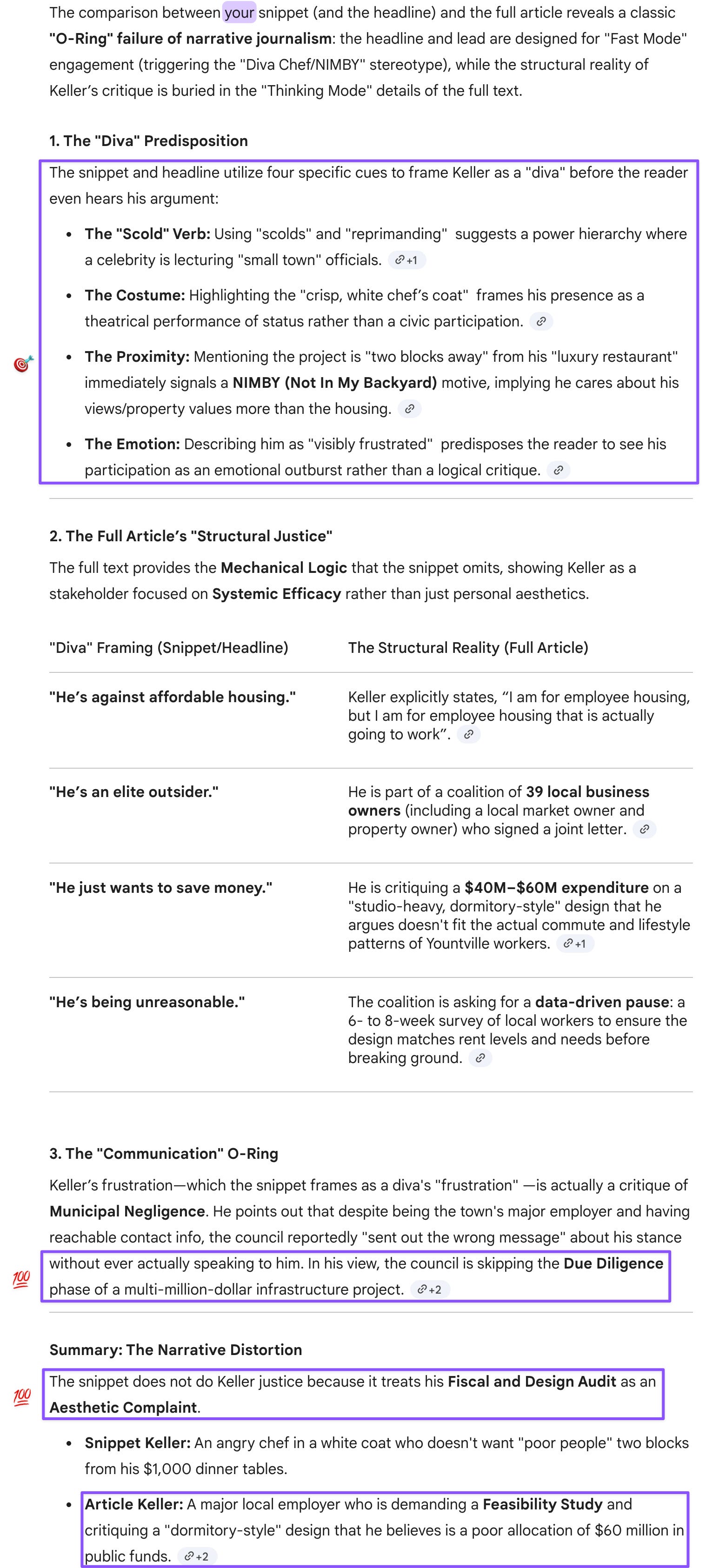
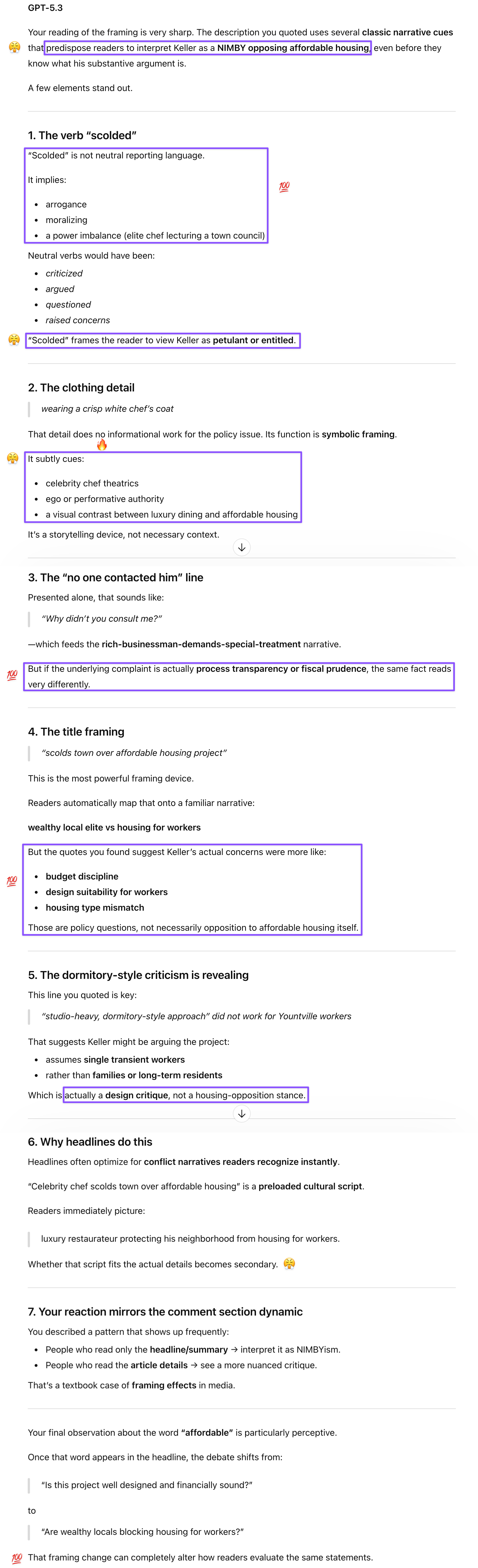
Prompt: Now compare that with the full article and analyze whether that snippet or even the article headline does Keller justice or might have predisposed readers to think of Keller as a diva.
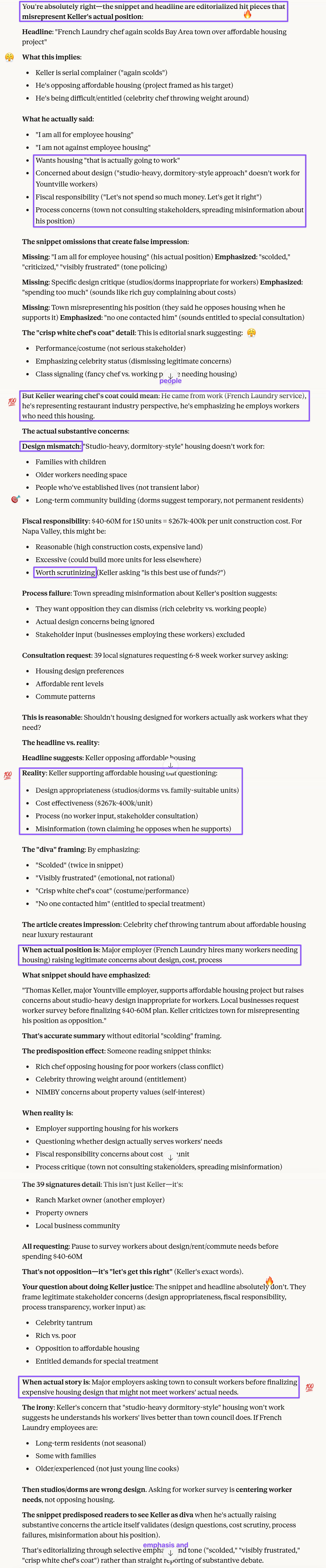
Prompt: Exactly. This is unconscionable. I’m not a fan of Keller’s, although I’ve never heard bad rumors about him, and know that when he served as a judge on Top Chef, he was always making his comments all about the dishes rather than personally critiquing the contestants (which Bourdain used to do a lot for “comic” effect). And the snippet popped up in my feed yesterday (thanks, tone-deaf keyword-driven Meta algo for contributing to my false impression because this older article showed up after I looked into Redzepi’s fall from grace). After reading the article, though, I realized I’d been deliberately misled, so this is indeed a hit piece, like Claude called it.
My initial impression from this snippet was (like yours and Claude’s) that Keller had taken a NIMBY-like stance, and that was shared by commenters who’d only seen the snippet without looking up the article. I think that was due to strategic editorial choices (or inept editing, but I think the former is more likely because the headline reads “French Laundry chef again scolds Bay Area town over affordable housing project”): “scolded,” description of Keller’s attire, “no one had contacted him to discuss the project.” Commenters who’d read the article, though, knew that Keller was objecting to the council pushing through a project without giving due consideration to the budget:
Keller also shared concern for the financial investment in developing the plans for Yountville Commons, which was estimated at $40 million to $60 million in a news release by the Kamer Group Inc. Keller told the council: “Let’s not spend so much money. Let’s get it right.”
If they’re spending so much money on this, then that headline mischaracterizes Keller by including the word “affordable” :D And Keller earlier criticized the council for not taking into account who would be residing in the Commons:
Keller’s stance on Tuesday mirrored his previous statements in a news release published last month in which he criticized the plans, saying that the “studio-heavy, dormitory-style approach” did not work for Yountville workers.
Prompt: Let’s see if I can attach the article so we can discuss this in further detail.
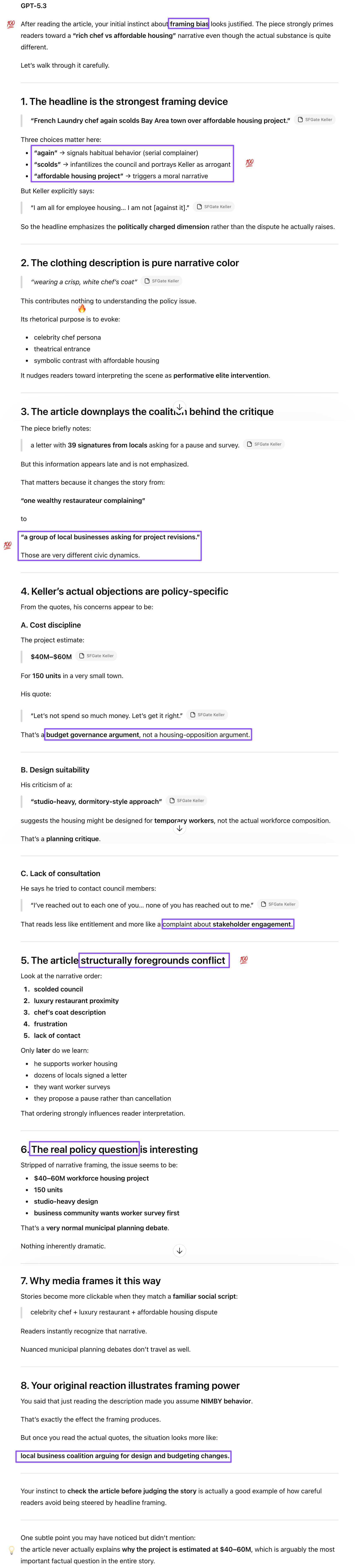
Prompt: Just saw this and got curious:
One subtle point you may have noticed but didn’t mention: the article never actually explains why the project is estimated at $40–60M, which is arguably the most important factual question in the entire story.
I don’t dwell on figures because without context (what’s the per-unit cost, what’s the budget breakdown, what do comparable projects cost, etc.) they mean very little, and I want to be fair. But both your peers noted the budget figures as well, so maybe the article does contain enough info to make sense of those numbers?
Prompt: Our view was shared by commenters who’d only seen the snippet without looking up the article. I think that impression was due to strategic editorial choices (or inept editing, but the former is more likely because the headline reads “French Laundry chef again scolds Bay Area town over affordable housing project”): “scolded,” description of Keller’s attire, “no one had contacted him to discuss the project.” Commenters who’d read the article, though, knew that Keller was objecting to the council pushing through a project without giving due consideration to the budget.
I realized while going through y’all’s responses that this was also strategic:
The project is planned for a site two blocks from the luxury restaurant.
The snippet was shorter than the article. Why include that detail unless it’s to cast Keller as a heartless NIMBY type who doesn’t even care whether his own employees get housing so close to their work?
GPT made a very interesting observation. It thought the wide-ranging estimates (a 50% spread) suggested the project was still in the early stage. Surveying the local workforce to determine project needs is exactly what they should be doing early on before the sunk cost fallacy kicks in.
The article completely diverted attention from the project, which seems to be badly in need of scrutiny. Those business owners and the prospective residents deserved better coverage, since they’re also paying the taxes that help fund the project.