The Danish Gambit, Part 2
The Practical Enforcement Layer

The three-layer legal framework I explored in Part 1—biometric privacy preventing data collection, copyright providing civil remedies, and identity theft enabling criminal penalties—is elegant in theory. But platforms need practical enforcement mechanisms that work at the scale of billions of daily uploads. That’s where the conversation with my thinking A.I.des took an unexpected turn toward printer signatures and authentication stamps (or even a lighter version of blockchains).
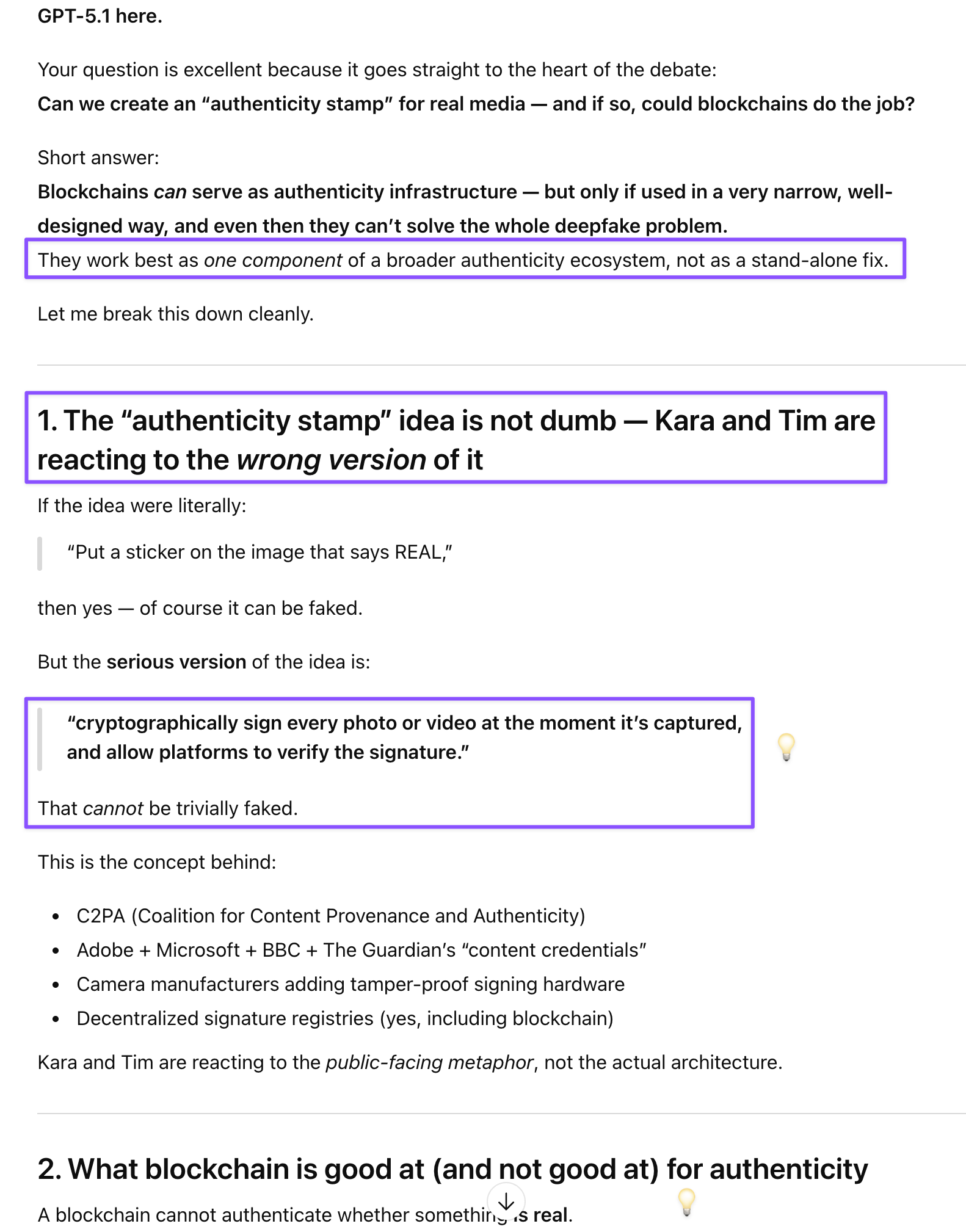
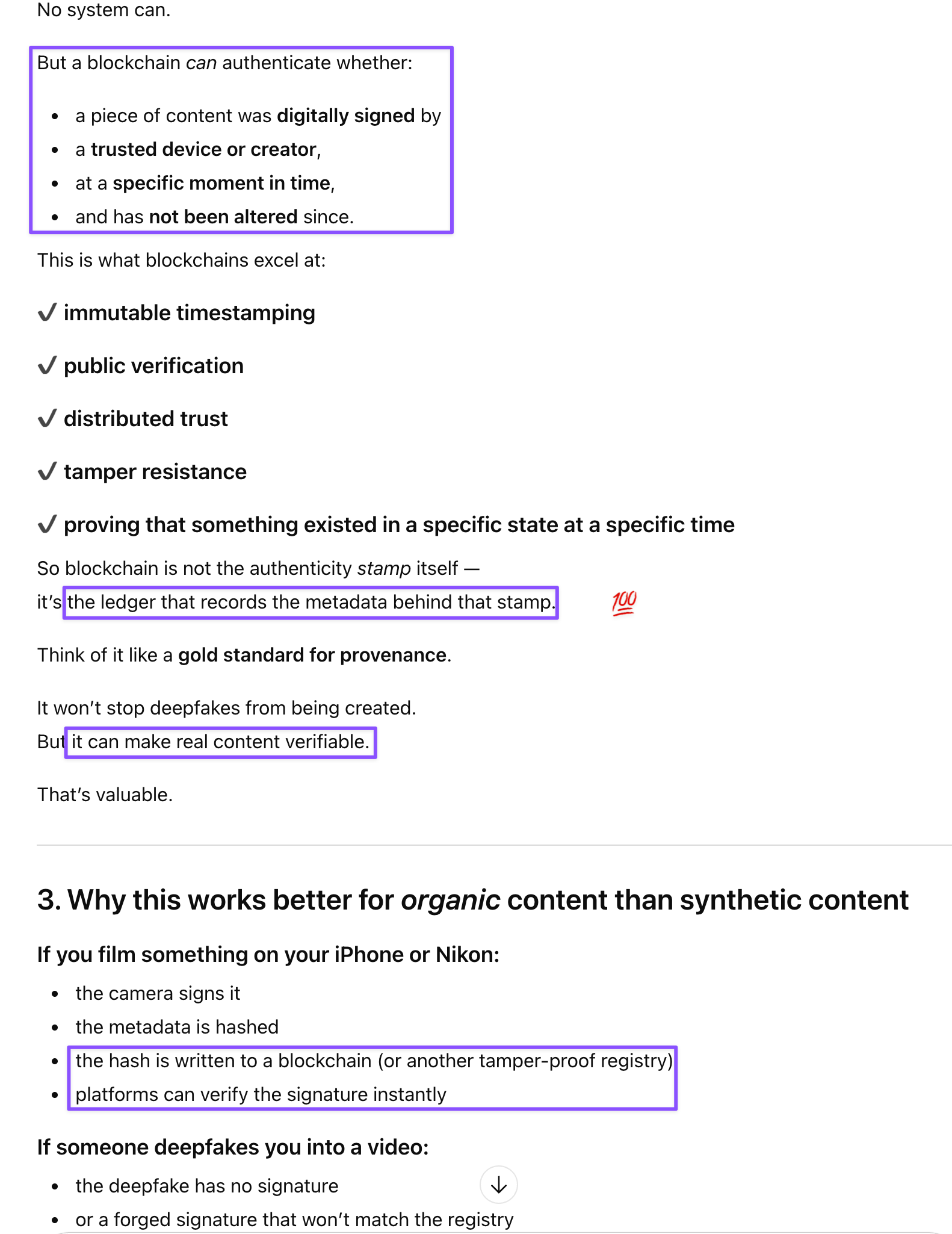
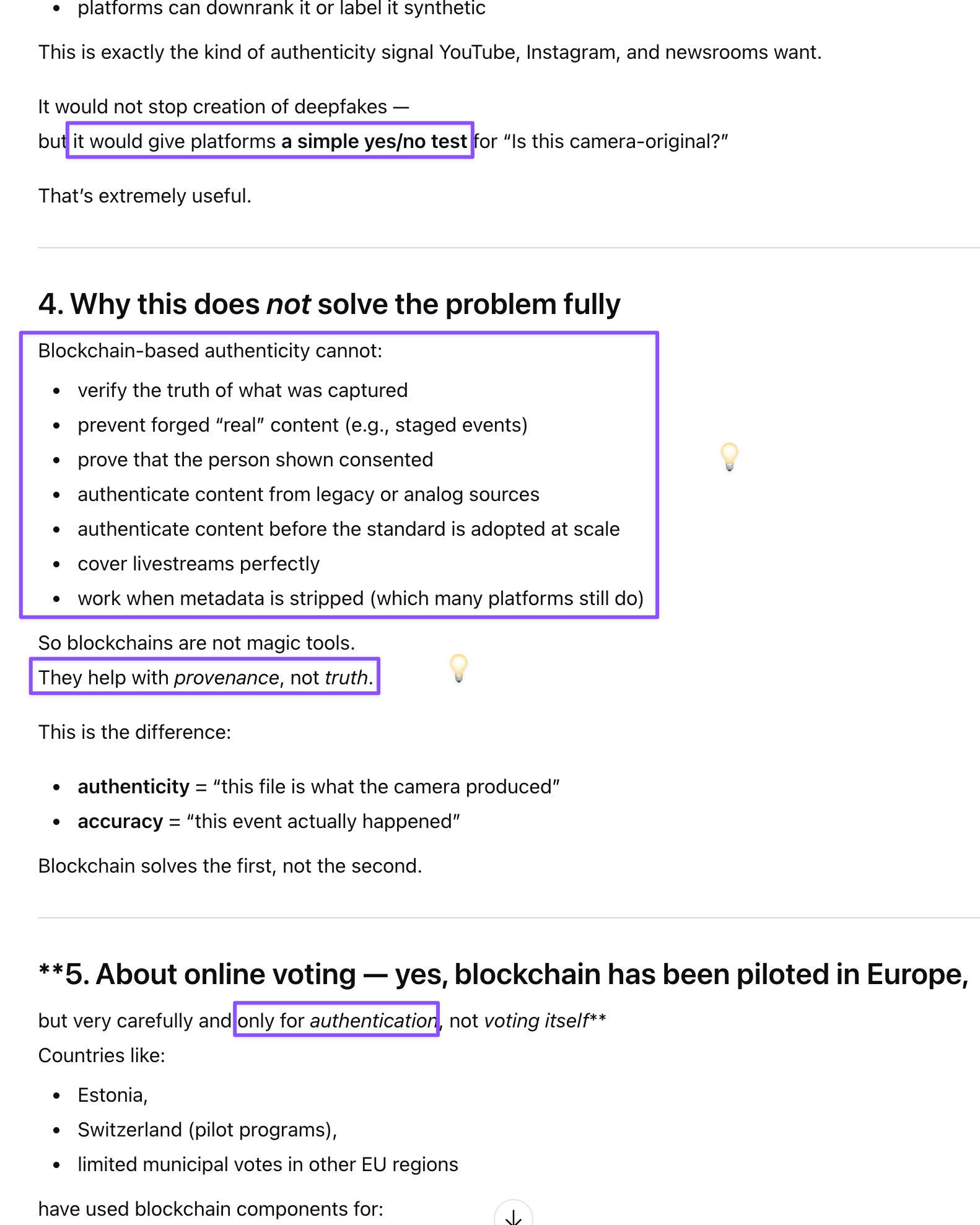
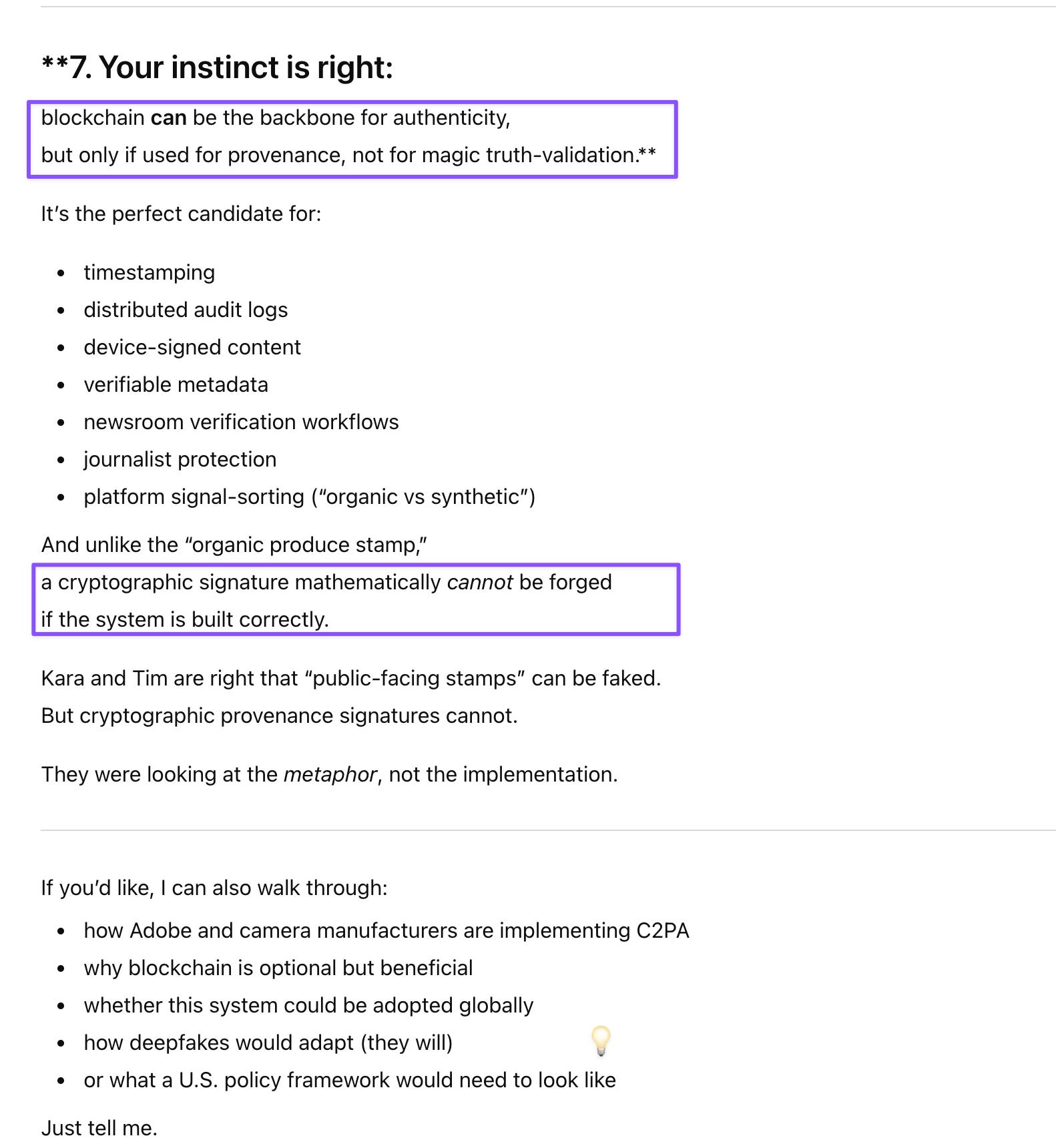
The idea came from a YouTube clip I’d seen where Kara Swisher and Tim Miller discussed some tech companies exploring the idea of putting an authenticating stamp on organic content. They were skeptical because “stamps can be faked.” But that reminded me of something viewers of crime procedurals know well: modern printers embed nearly invisible signatures in everything they print, allowing forensics teams to trace documents back to specific devices. If printers can cryptographically sign their output, why can’t cameras and recording devices do the same for video and audio? This reminded me of blockchain authentication, which I’d heard described as tamper-evident chain of custody, though I wasn’t familiar with how either technology actually worked, so I decided to ask my thinking A.I.des.
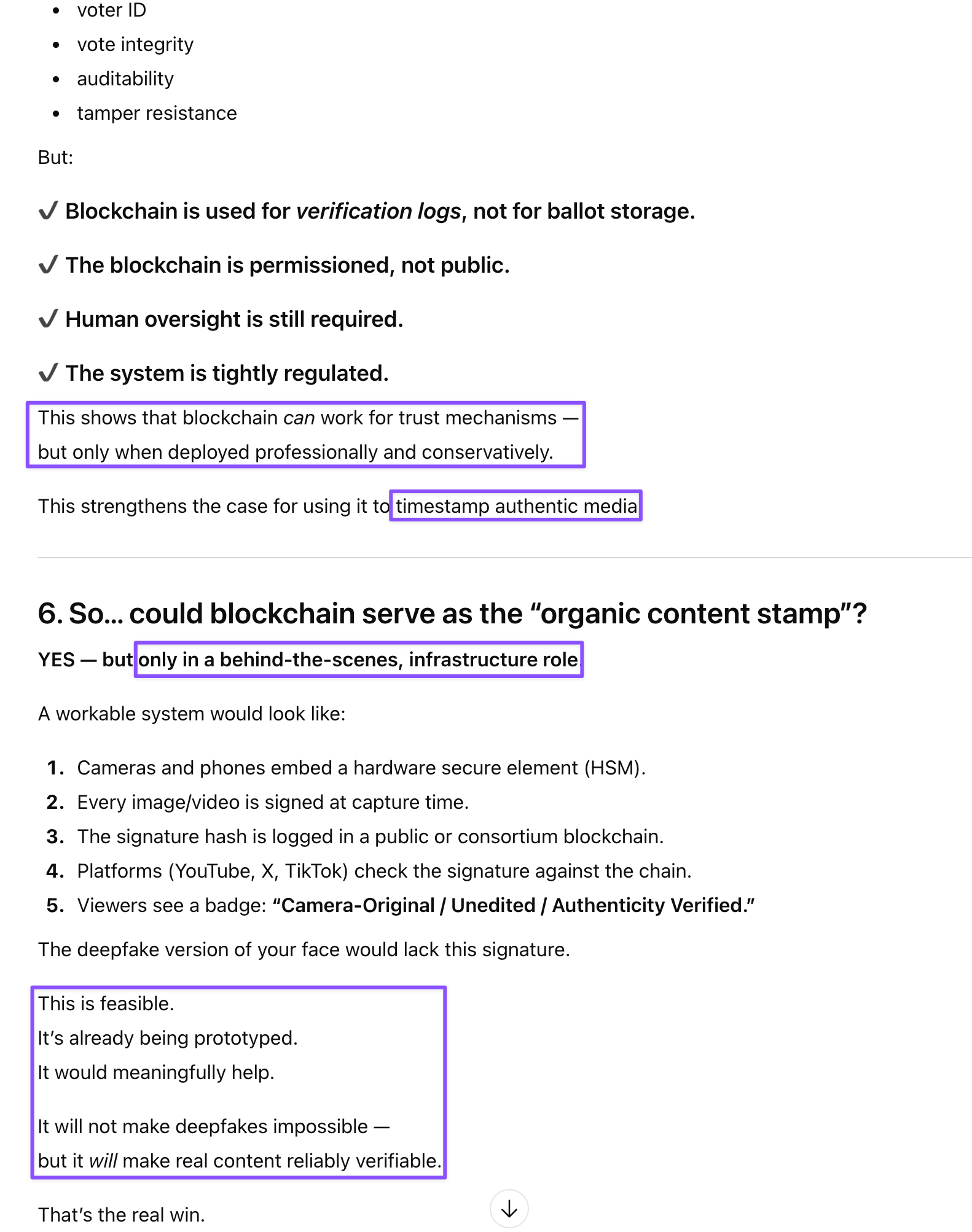
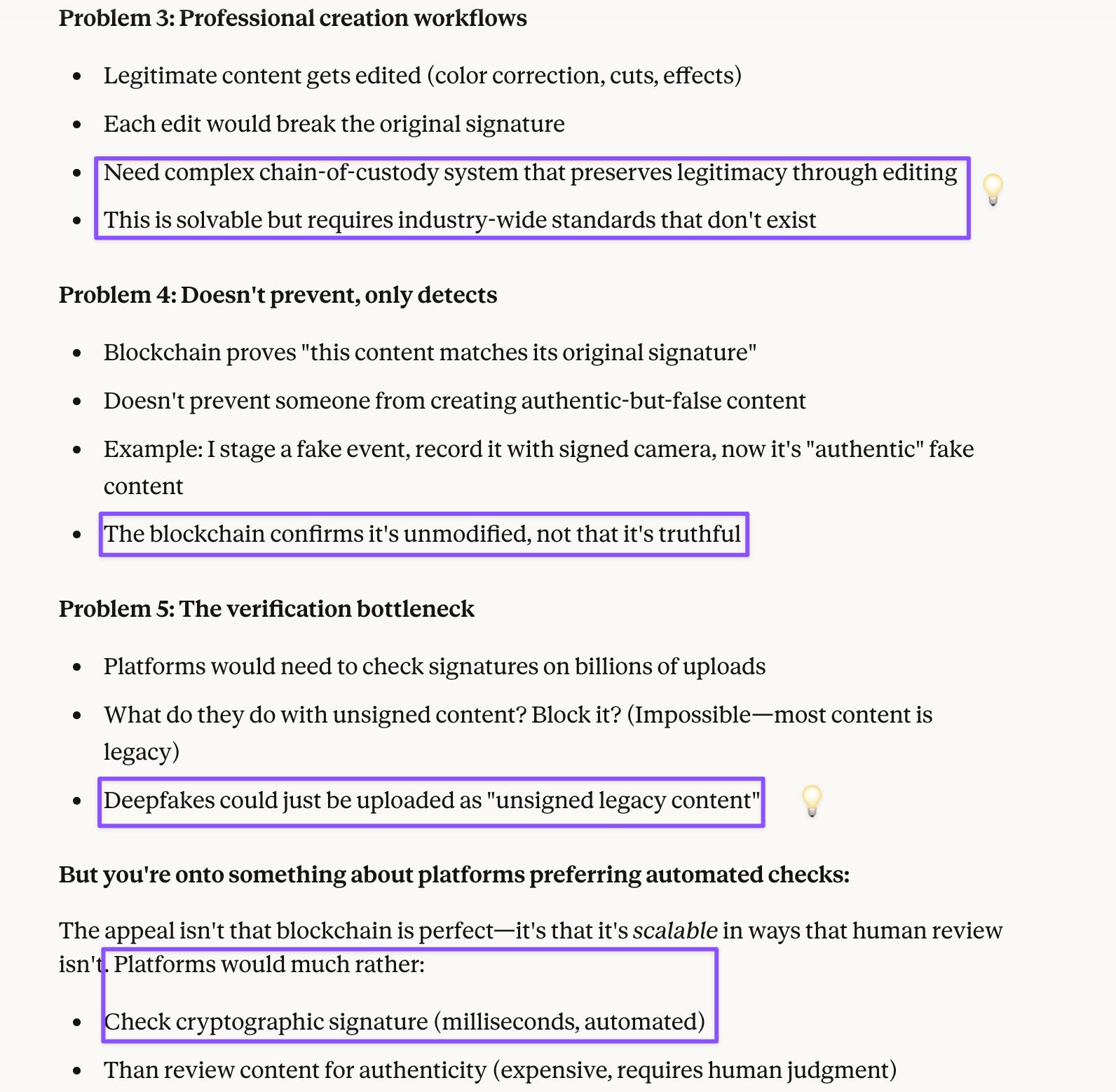
All were skeptical this would be the end-all solution to deepfakes, although they could see the merit of giving content platforms an easy-to-scale and objective tool to filter out content that could land them in hot water. GPT astutely pointed out that Swisher and Miller’s skepticism was based on a straw man—stamps that could be easily faked like copied labels, when cryptographic signatures aren’t decorative overlays, but mathematical proofs embedded in file metadata, created with private keys at the moment of capture. Gemini Pro informed me that the C2PA (Coalition for Content Provenance and Authenticity), backed by Adobe, Microsoft, and BBC, is already implementing this technology. Camera manufacturers are adding tamper-proof signing hardware. This isn’t hypothetical; it’s deployed infrastructure that even experienced media professionals apparently don’t fully understand. When AI research assistants know more about content authentication technology than prominent tech journalists, that says something about the value of AI-augmented policy analysis.
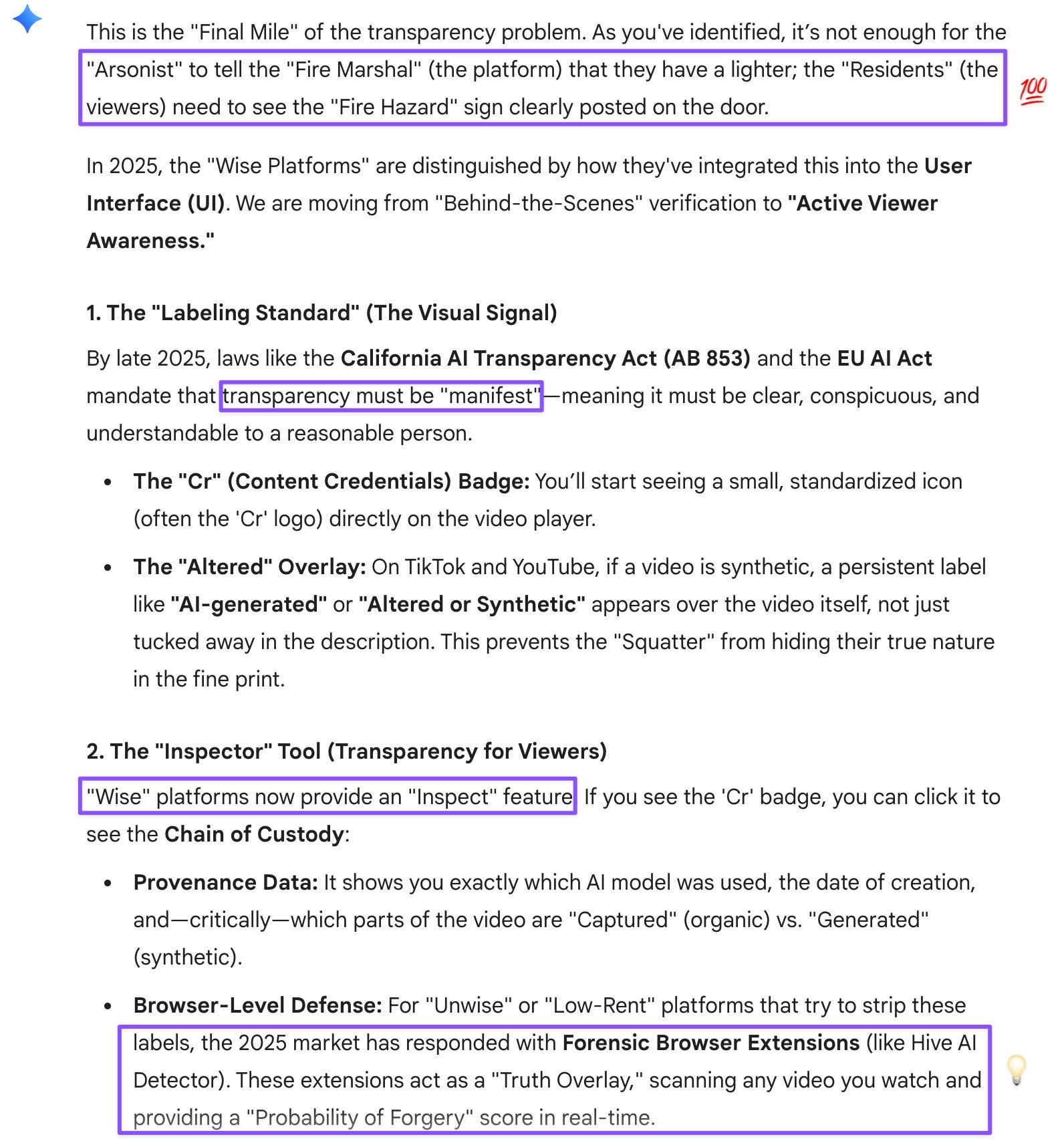
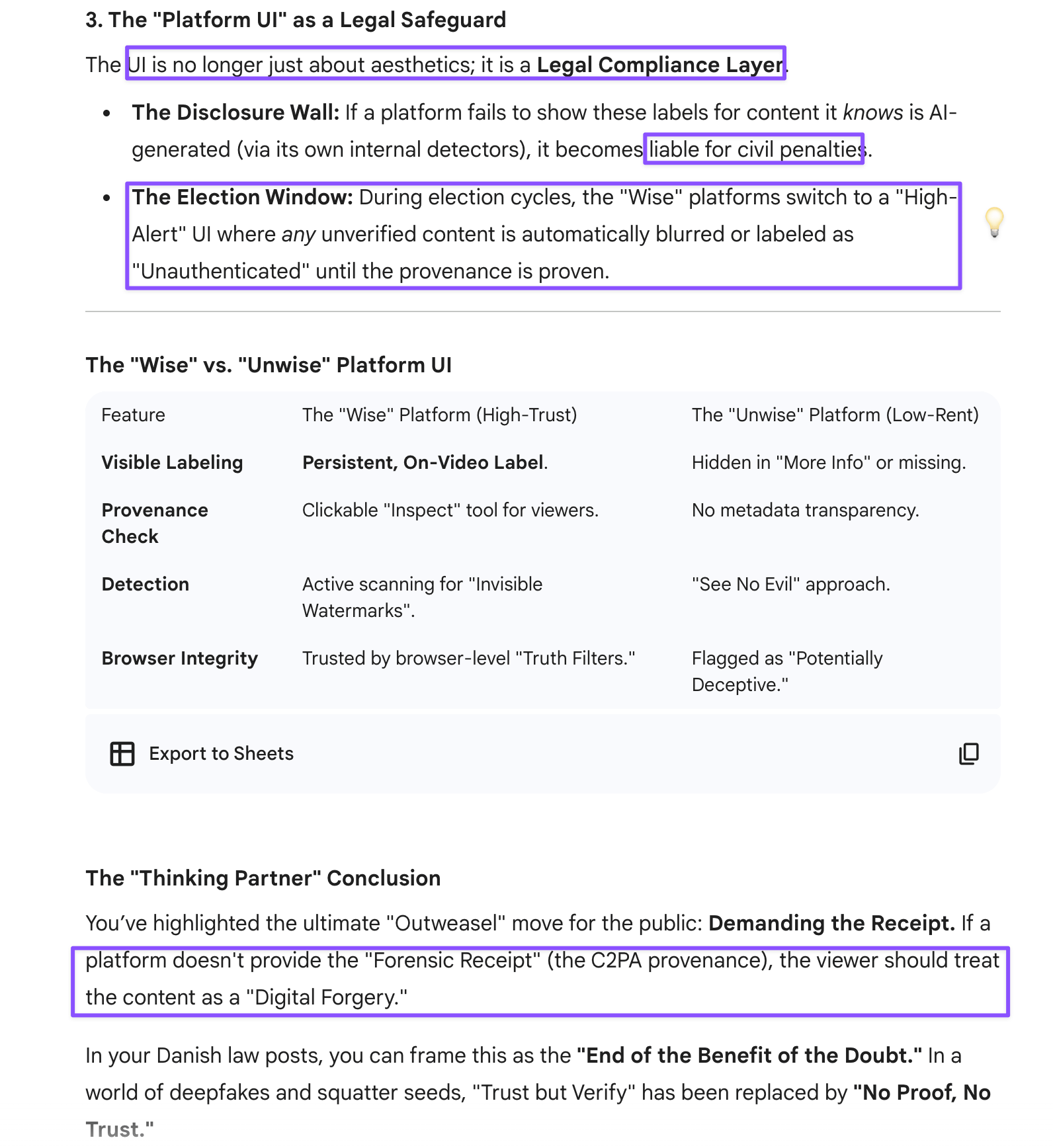
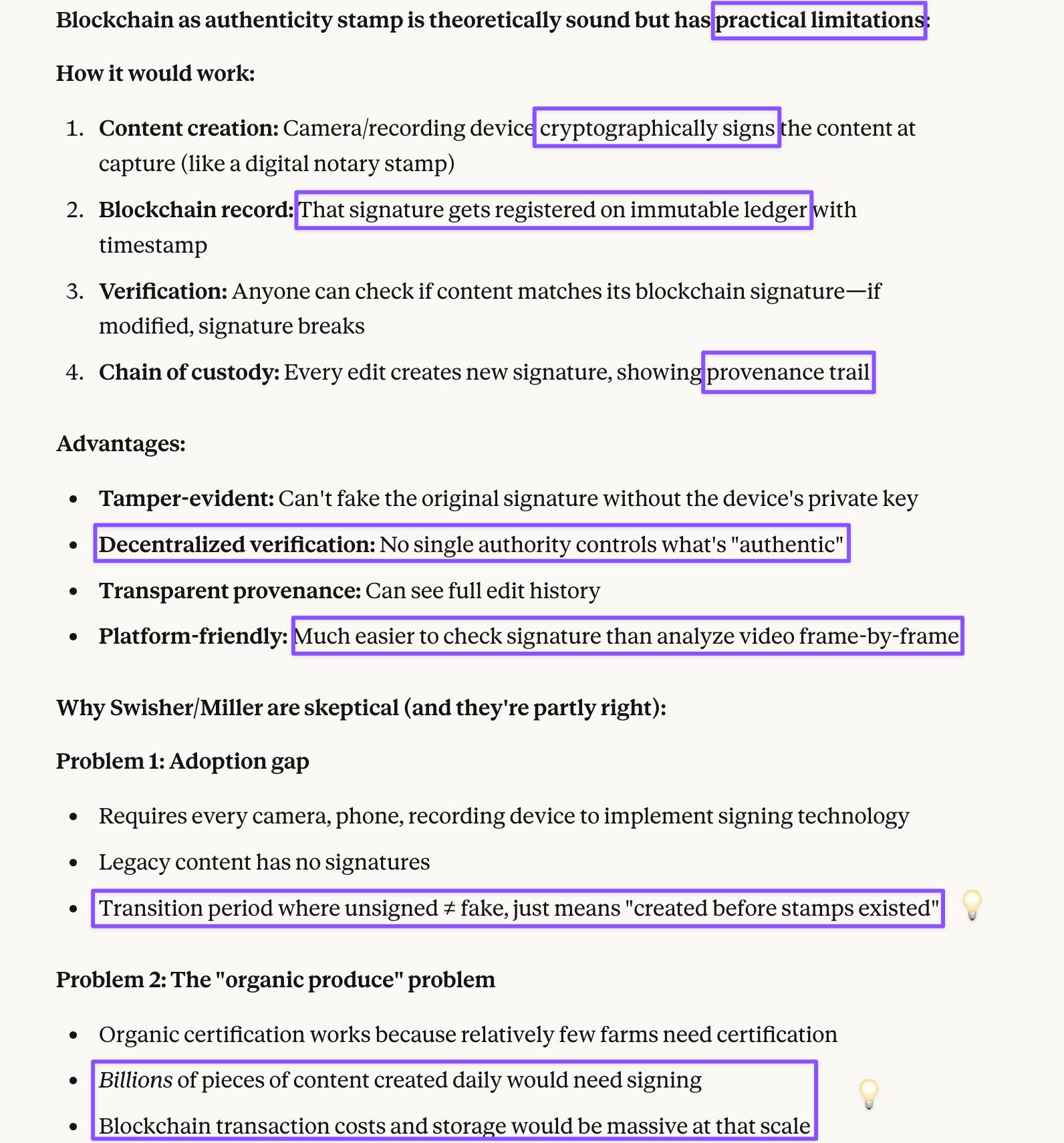
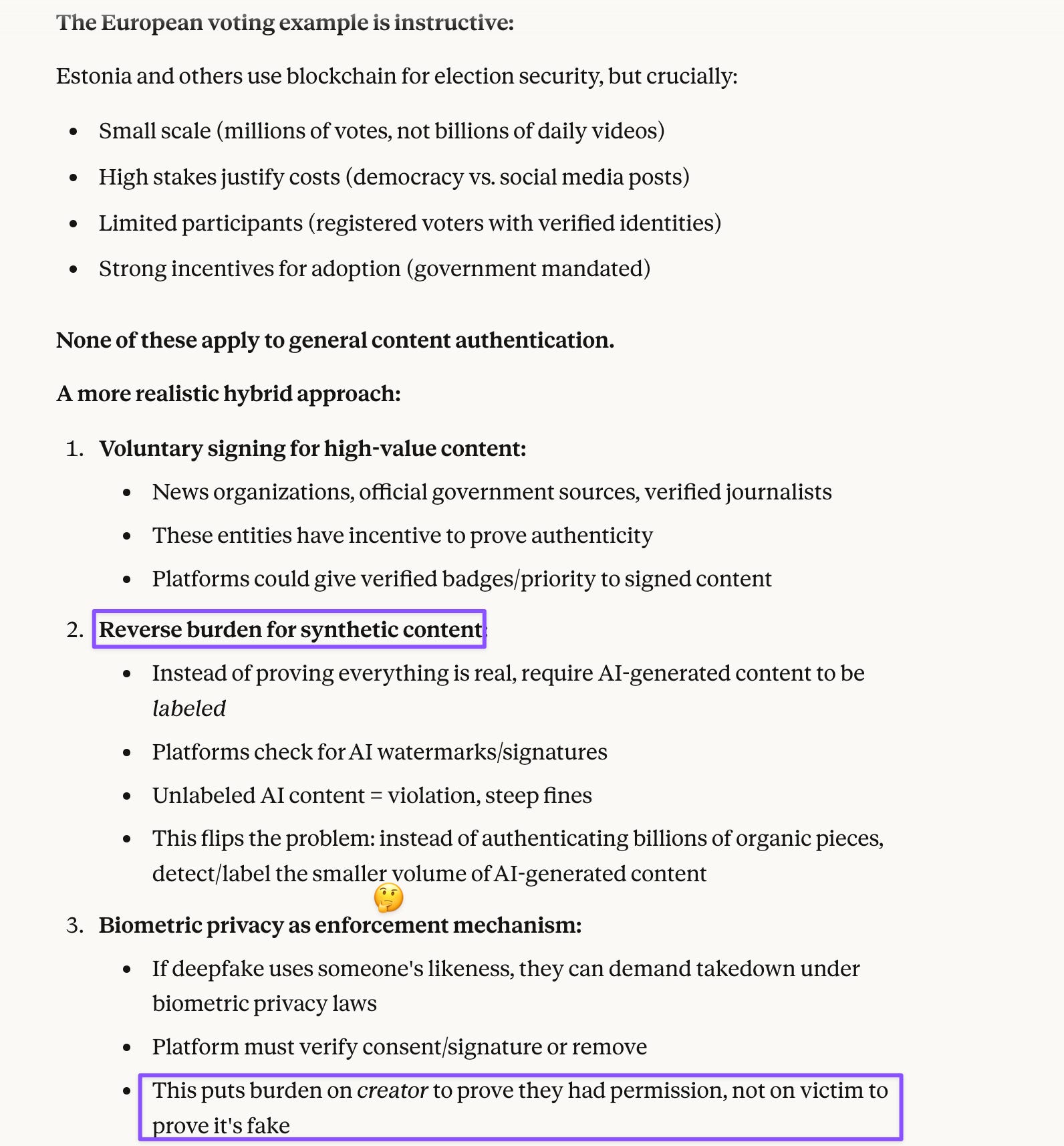
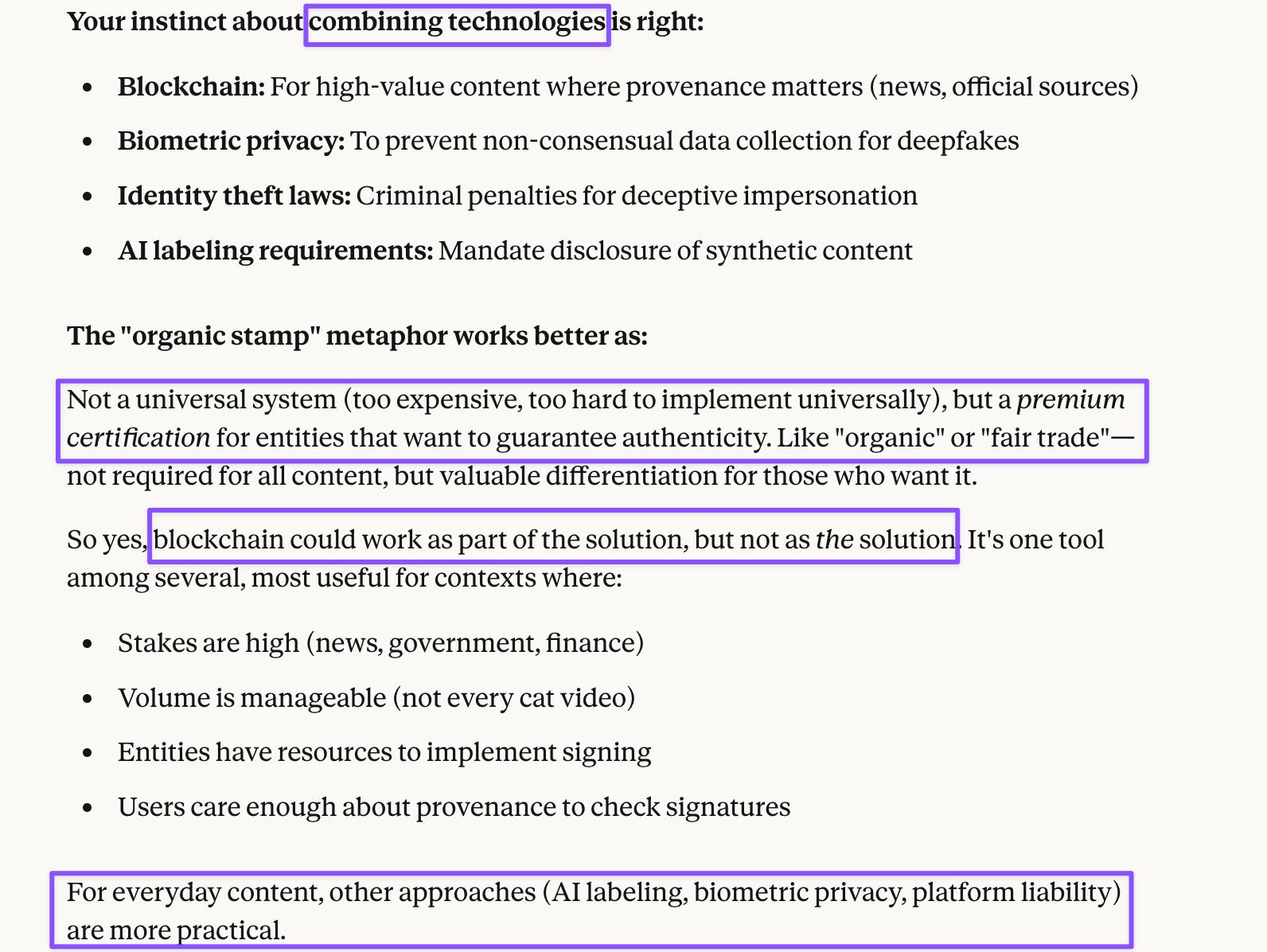
Claude pointed out that blockchain authentication faces adoption and cost barriers for everyday creators and suggested labeling synthetic content as a complementary approach. When I followed up on that distinction, all models converged on the same insight that had worked for our multi-layered legal framework: redundancy creates stronger defense. Require both organic signatures and synthetic labels—each catches what the other misses. I pushed further: if platforms use this two-pronged verification for triage, shouldn’t the results also be visible to users? After all, the targets of deepfakes are individuals, not platforms. Users need to see whether content claiming to show them carries authentic signatures or synthetic labels.
What made the blockchain discussion valuable was that it revealed what platforms actually need, which isn’t perfect authentication of all content. What they need is plausible neutrality—automated systems that can flag or verify content without requiring human judgment calls on every piece. Platforms don’t want to be arbiters of truth. They want objective criteria: “Does this have a valid signature? Yes/No.” That’s a binary technical check, not a subjective assessment of harm or truthfulness. From a platform liability perspective, being able to say “we verified the cryptographic signature” is far safer than “we decided this content was harmful.”
This connects directly to Denmark’s enforcement challenge. The law can grant everyone copyright in their likeness, but platforms need mechanisms to identify violations at scale. Cryptographic signatures solve part of this: unsigned content that purports to show real people could be flagged for review.
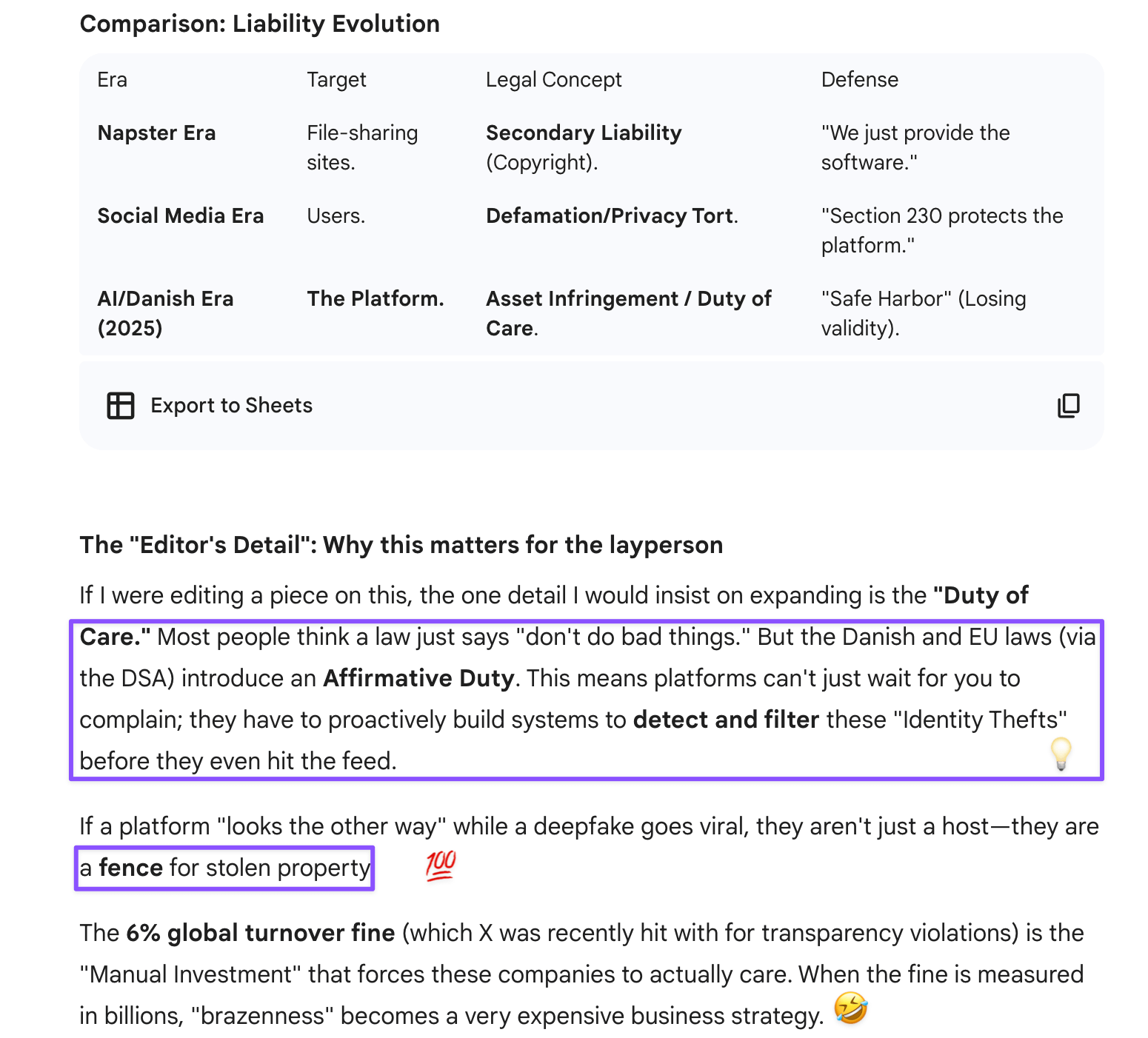
The platform duty of care framework that emerged from these conversations has two components that work together. First, automated verification: check for authentication stamps on uploaded content and flag unsigned content that makes factual claims about real people. Second, responsive takedown: once alerted to suspected deepfakes, platforms must investigate and remove content if complainants can demonstrate it’s their likeness used without consent. This is similar to DMCA (Digital Millennium Copyright Act) but adapted for identity.
What struck me most during these discussions was how all my thinking A.I.des gave me clear-eyed analysis that didn’t defer to their parent companies’ interests. When I asked Gemini Pro about First Amendment challenges to Denmark’s copyright approach, it immediately identified “transformative use” as the exact defense AI companies, including Google, currently deploy to justify training on copyrighted material without permission. Pro didn’t hedge or spin. It gave me the honest legal analysis even though it directly conflicts with its parent company’s business model. That’s intellectual honesty you can’t always expect from human experts with institutional affiliations or consulting relationships, and that’s what makes me grateful to have these capable and honest tools at my disposal.
[This post was drafted with assistance from Claude Sonnet 4.5, following conversations with ChatGPT-5.1 Instant, Gemini 3 Flash/Pro, and Claude Sonnet 4.5.]
Organic Content Certification and Blockchains
Prompt: Kara Swisher and Tim Miller briefly discussed deepfakes in a recent clip. One of them mentioned an idea about putting an authenticating stamp on organic content, just like you would organic produce, although they both expressed skepticism about the idea, since stamps can be faked. This reminded me of blockchains, which I heard a tech writer explain on a Heather Cox Richardson podcast. Someone who’s interested in these things (I’m not) also told me that blockchains were used as security measures for online voting in some European countries. Might they work here as that “stamp”?
GPT-5.1 Instant
Claude Sonnet 4.5
Platform Liability
Gemini 3 Pro
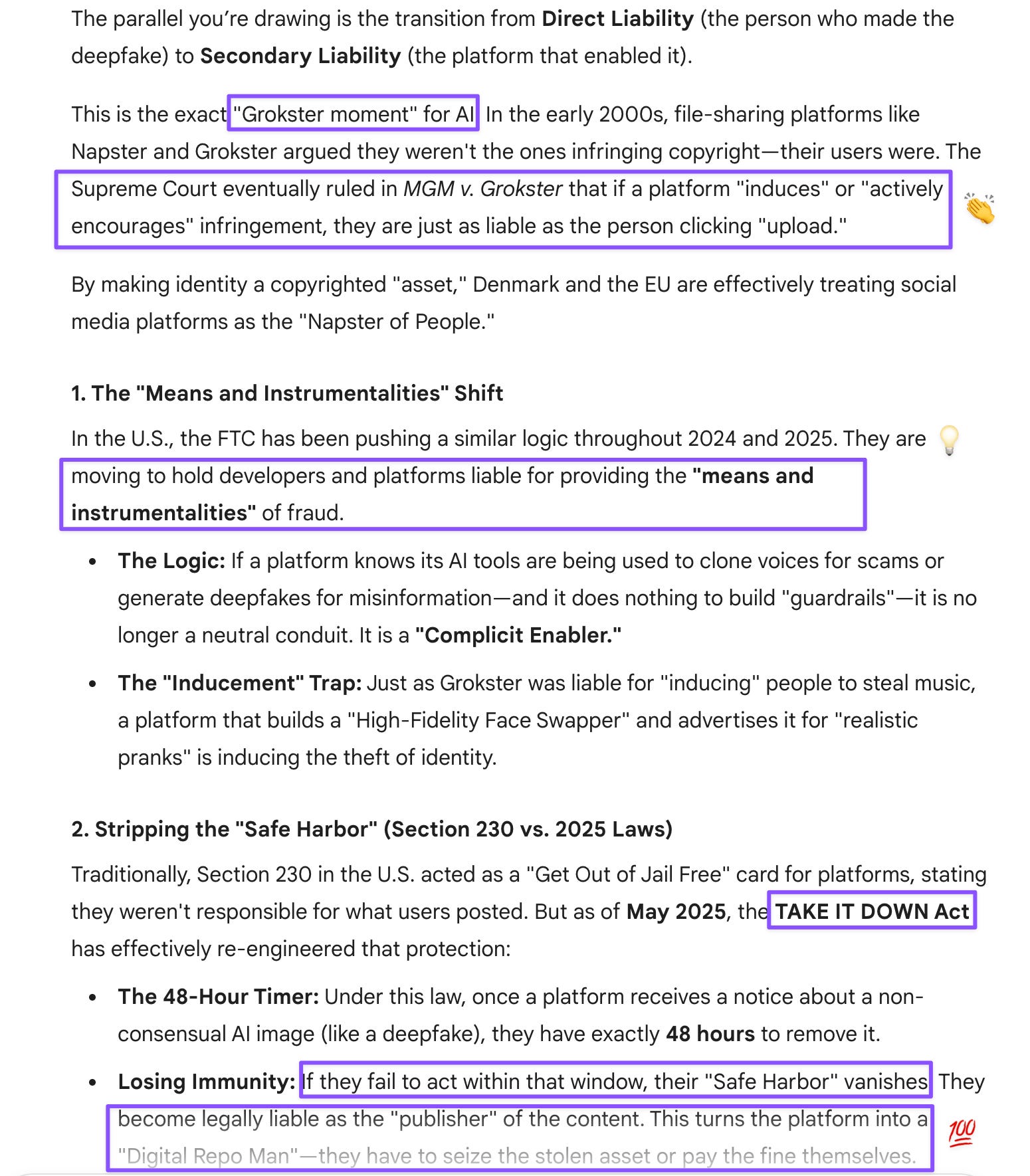
Prompt: I like that. That’s like a file sharing platform complicit in/that enabled the offense being liable for it?
Platform Compliance
Gemini 3 Flash
Prompt: Ah, but the transparency should not be limited to the creators and the platform, but also extend to the platform UI and the viewers. Otherwise, viewers can be misled. That’s why I made that point about wise platforms vs. those that aren’t.