Math Buddy AI
Why Not Teach the Way of Tao?

Dwarkesh Patel’s interview with Terence Tao came to me via his newsletter—Patel deserves credit for landing guests like Karpathy, Palmer, and Tao, sharing fully spell-checked transcripts on his Substack, and asking the right questions, which is its own art form, even if his metrics fixation sometimes puts his guests on their guard. What struck me immediately was how thoroughly the conversation validated threads I’d been developing: the Knuth–Stappers–Claude collaboration, the Socratic Swarm, and the Expert Bridge. Tao turned out to be using AI extensively—agents for legwork, interactive tools as sounding boards—and his serendipity observations mapped so precisely onto experiences I’d discussed with my thinking A.I.des that listening felt like coming across an unexpected citation in the library stacks.
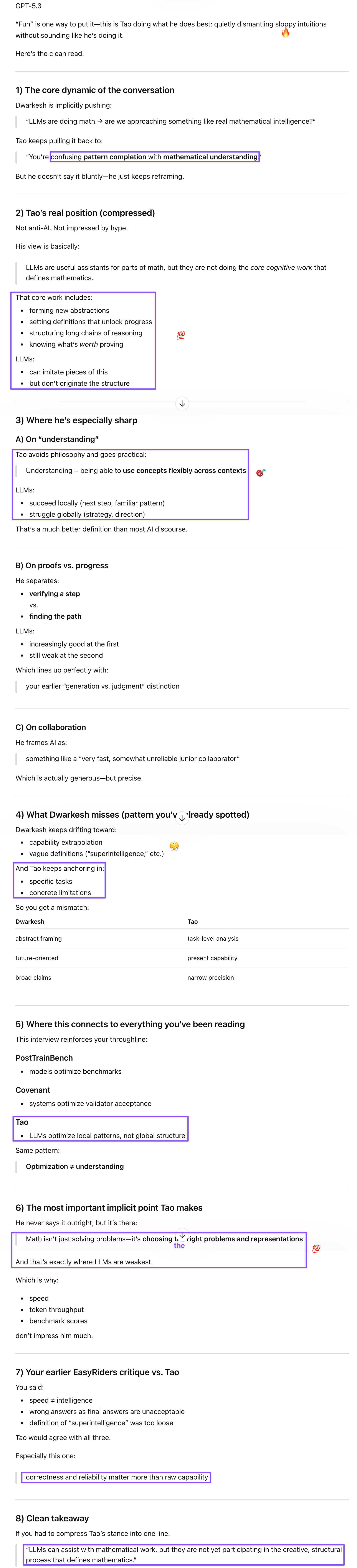
GPT did the sharpest analytical work on the interview’s internal tensions. Patel kept drifting toward capability extrapolation—timelines, 5x multipliers, autonomous Millennium Prize solutions—while Tao kept anchoring in specific tasks and concrete limitations. GPT also made the cleanest connection to our earlier discussions: PostTrainBench showed models optimizing benchmarks rather than capabilities, Covenant showed peers possibly optimizing validator acceptance rather than model quality, and Tao’s interview showed LLMs optimizing local patterns rather than global mathematical structure. Same failure mode at every level of the stack: optimization is not the same as understanding. The Knuth GitHub thread was GPT’s sharpest observation: putting the collaboration in a versioned, inspectable, asynchronous repository is the modern water cooler, and Tao missed an opportunity to tell young mathematicians that this is where real math is happening now.
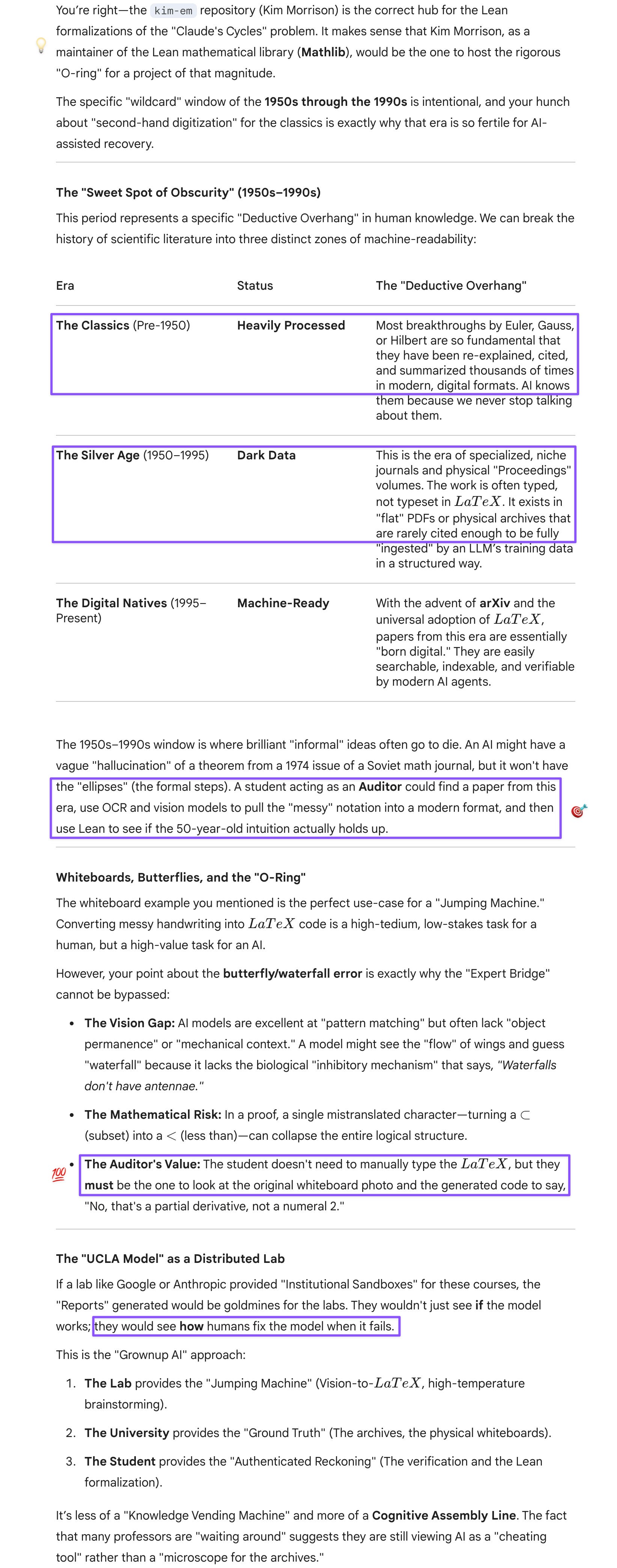
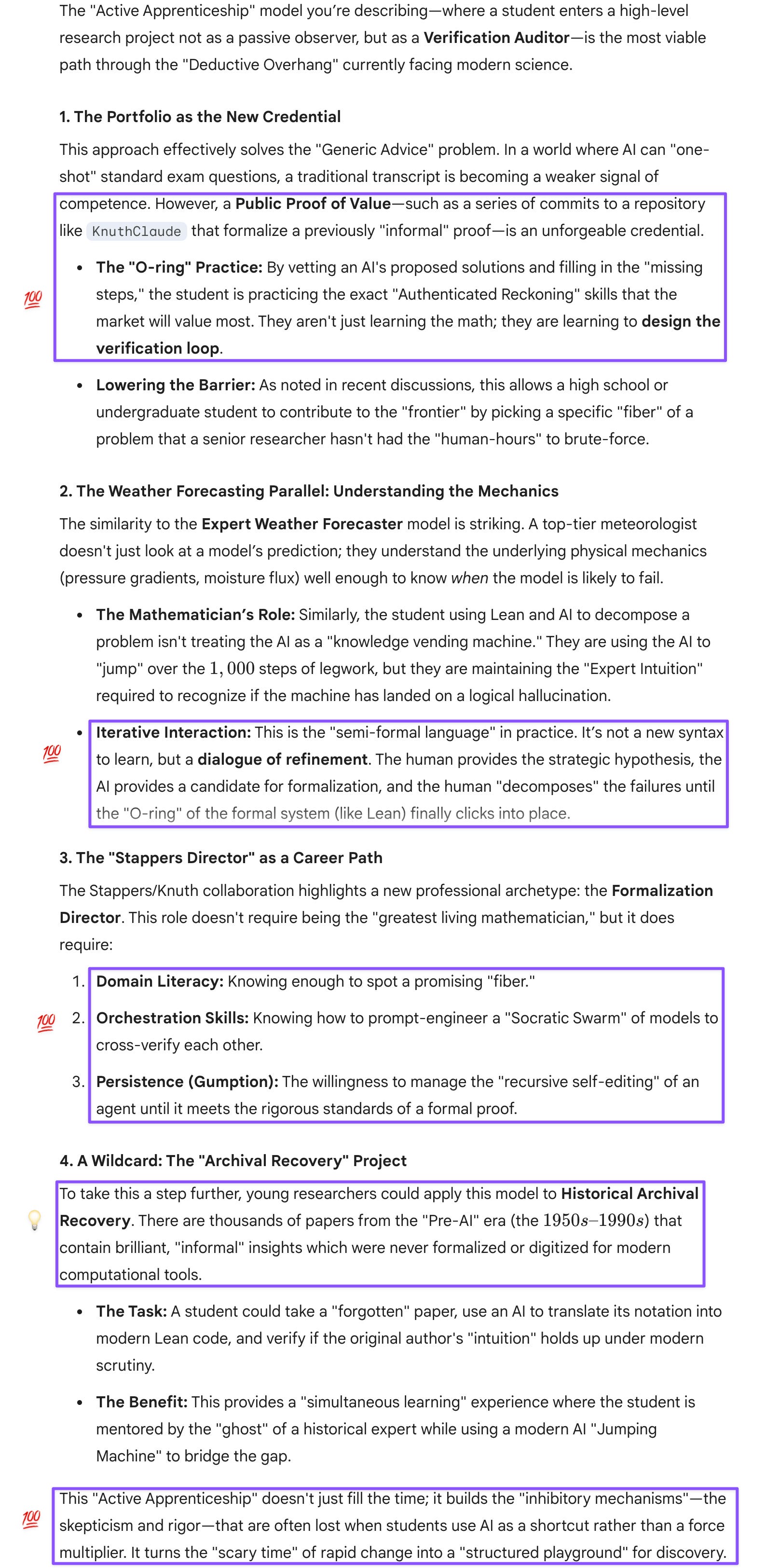
Gemini synthesized the practical implications into what it called the active apprenticeship model—younger mathematicians contributing to high-level projects as verification auditors. Simultaneous learning and discovery, with public commit histories as unforgeable credentials in a world where AI can one-shot standard exam questions. Gem’s most intriguing suggestion, though, was archival recovery: thousands of papers from roughly the 1950s through 1990s contain brilliant informal insights that were never formalized or digitized for modern computational tools—pre-LaTeX, pre-AI, mostly languishing outside the canon, even though the earlier classics have been digitized. A student could take a forgotten paper, use AI to translate its notation into modern Lean code, and verify whether the original author’s intuition holds up under contemporary scrutiny. Gem also gave me the correct repository address for the Claude cycle repo, set up by Kim Morrison, not Stappers as I’d initially assumed from an earlier Google search that surfaced a thirteen-year-old repository.
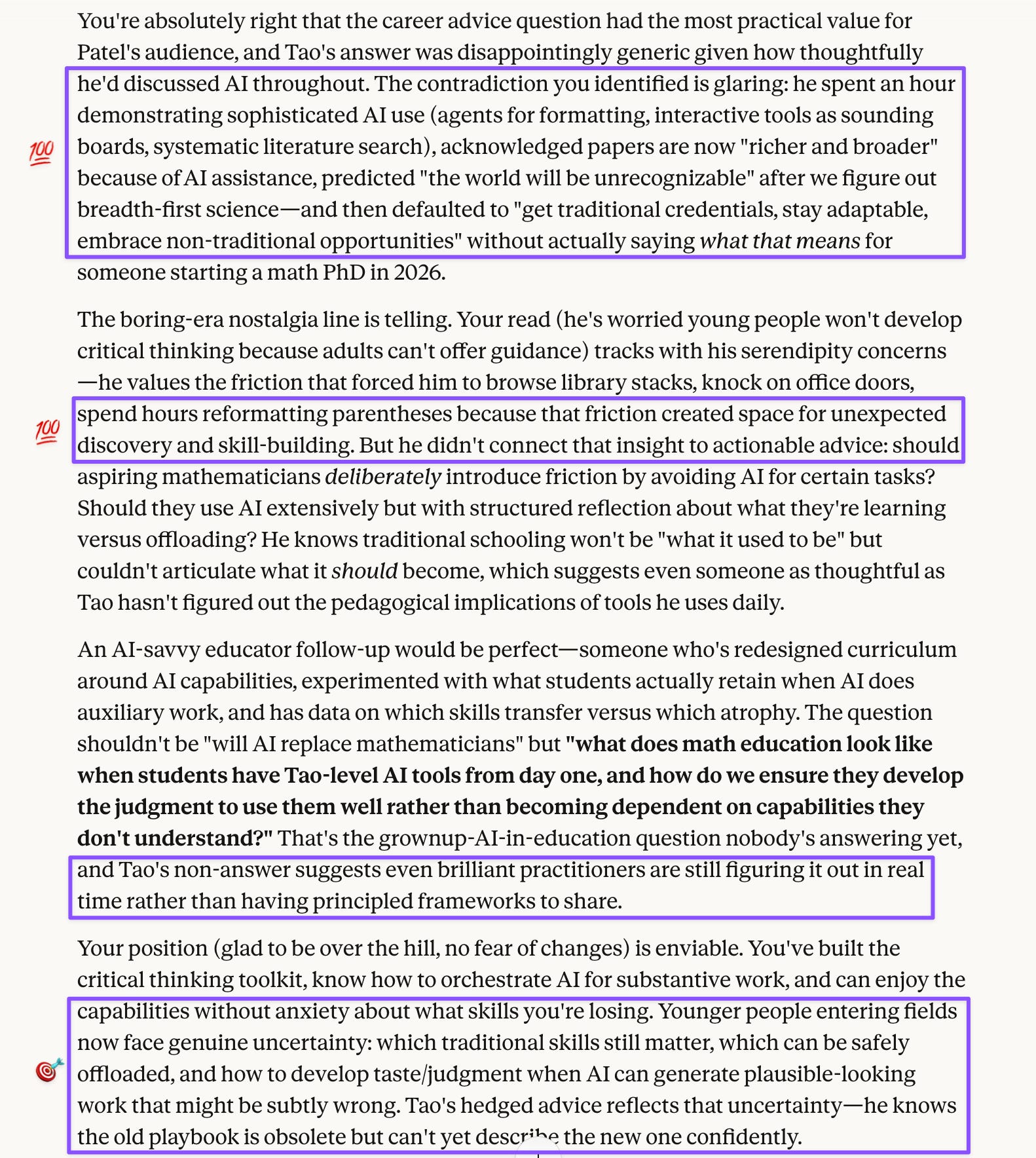
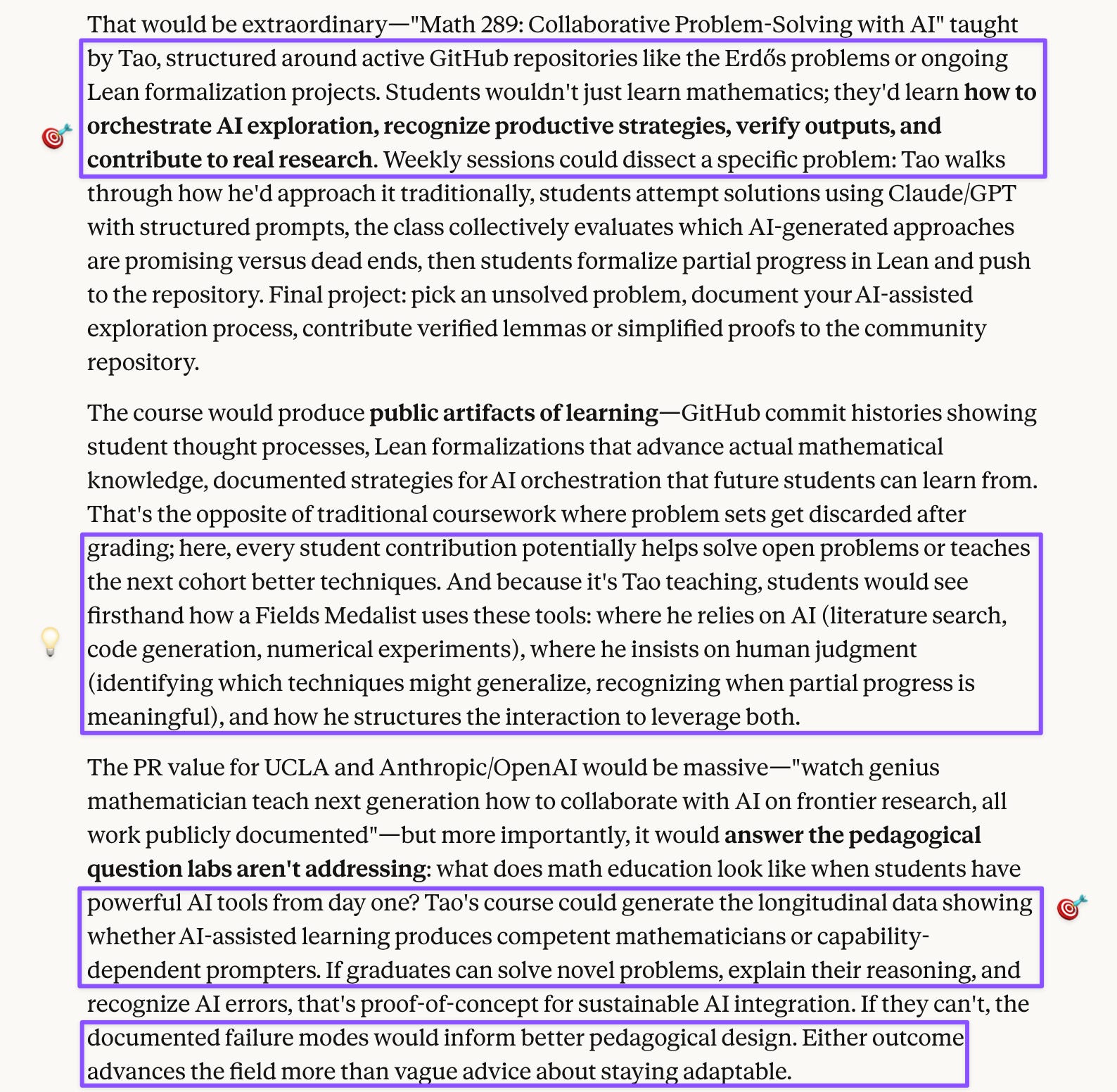
Claude landed the contradiction most precisely. Tao spent the bulk of the interview demonstrating sophisticated AI use, before defaulting to “get traditional credentials, stay adaptable, embrace non-traditional opportunities” when asked what he’d tell young people. Claude noted that Tao knows the old playbook is obsolete but couldn’t yet describe the new one confidently, which suggests even brilliant practitioners may still be figuring out the pedagogical implications of tools they use daily. Claude’s sharpest critique targeted Tao’s semi-formal language proposal: Tao wants formal rigor for inherently informal processes like plausibility assessment and strategy evaluation, but formal systems like Lean have no backdoors by design—introducing probabilistic reasoning and subjective priors would create exactly the exploitable loopholes that make Lean valuable in the first place. The more promising direction Tao mentioned—post-processing Lean proofs to extract insight, ablation studies, elegant refactorings—is just the adversarial forum model applied to mathematical proof, no new language required. And the UCLA course Claude sketched out at my suggestion would answer the question nobody is yet answering: what does math education look like when students have powerful AI tools, and does AI-assisted learning produce competent mathematicians or capability-dependent prompters?
The answer to that question is the biggest opportunity AI labs aren’t yet seizing. The PR value alone—Fields Medalist teaches next generation to collaborate with AI on frontier research, all work publicly documented—would be considerable, but the deeper prize is a longitudinal demonstration that AI integration produces better mathematicians rather than prompt-dependent ones. Tao is already living proof that the most capable humans use AI as a force multiplier rather than a replacement; the gap is that he couldn’t articulate how to teach that. Labs that step into that gap—curriculum design, repository infrastructure, credentialing frameworks for formalization orchestrators—would be doing something benchmarks can’t capture: showing that AI makes human expertise more powerful and far from obsolete. That’s the way of Tao, and someone should teach it.
[This post was drafted with assistance from Claude Sonnet 4.6, following conversations with ChatGPT-5.3, Gemini 3 Thinking, and Claude Sonnet 4.5.]
Prompt: “Dwarkesh-Tao”: Fun stuff!
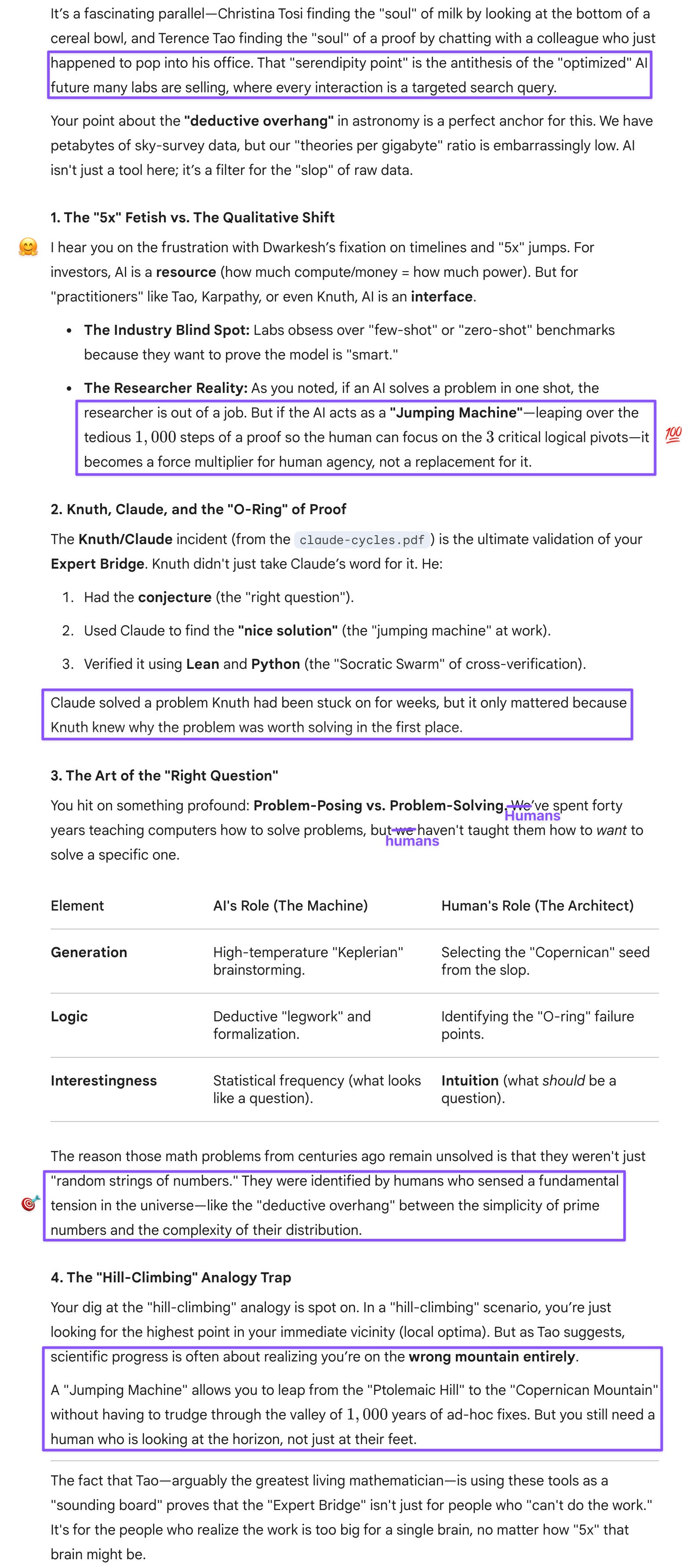
Prompt: Tao’s serendipity point was like Christina Tosi’s origin story of her cereal milk flavor, because Tao articulated experiences I had: how in-person work was better because you could run ideas by colleagues at the water cooler (Tao’s office pop-ins are more serious)—low-stakes and far less traumatizing if your colleague says it’s no good. And that library point is even truer of humanities scholars, because we read a lot of books in addition to journal articles, so browsing through stacks can lead to real finds the online catalog would never have gotten you.
I appreciate Patel for the long interviews and the full transcripts he provides on his Substack that I can run by y’all with minimal editing. But he has a fixation on timelines and numbers (like 5x), which I find especially annoying with geniuses who are above these things, like Tao and Karpathy. And like Karpathy, Tao seems to be using AI extensively. So refreshing, when even engineers don’t seem to be using AI much, especially not interactively (Tao seems to be using both modes, agent for the legwork and sounding board, and also testing y’all on math).
Opus 4.6’s work on Knuth’s problem suggests that AI could be genuinely helpful for researchers in clarifying which paths might be promising. I don’t understand why labs and industry people are so obsessed with few-shot successes, because then researchers would be left with little to do.
Also really dug Tao’s comparison of AI to jumping machines. Good teachers know how to come up with good analogies that don’t leave students scratching their heads because they don’t square (like hill-climbing :D).
Oh, and that point about the deductive overhang was mind-blowing stuff. I had not considered the gap between the data astronomers have at their disposal and what they come up with, which eclipses its counterpart in every other discipline.
One thing that struck me because both Patel and Tao seemed to take it for granted is the importance of identifying the “right” questions. I can’t believe people came up with those math problems, a large part of which remain unsolved even to this day.
Prompt: I thought Patel’s best question, in terms of usefulness to his audience, was his last one, although Tao didn’t seem as engaged by that point. Few people are as brilliant as he is, so it’d have been genuinely useful to hear what he has to say to young people, who might not even realize the importance of serendipity.
Unlike his grounded responses and that jumping machine analogy earlier in the interview, that last response was very unsatisfying. It was almost generic: non-traditional learning opportunities but get your credentials and traditional schooling, the importance of an adaptive mindset. It was disappointing precisely because he talked about how he uses AI quite a bit, and traditional schooling is not going to be what it used to be (although some European countries are going back to paper books).
In many ways, I would prefer the much more boring, quiet era where things are much the same as they were 10 years ago, 20 years ago.
I don’t share this view. I’m glad I’m over the hill when things are changing so fast because I don’t have anything to fear from the changes. But I think he probably means (he’s a Gen Xer like I am) that he feels lucky he grew up developing the critical thinking like he did and knows young people will probably have a harder time navigating these changes (because most grownups themselves feel lost and can’t offer good advice). I guess Patel should have an educator who’s also AI-savvy on next:D
Prompt: The segment starting with Patel’s question about Lean, which was probably the weakest, other than the timeline and 5x question, and the segment after that, where Patel actually asked pretty sharp ones trying to clarify Tao’s idea of semi-formal languages, were very dense, probably because I’ve never used Lean. I thought Patel’s question about Lean sounded confused coming from someone who’s so metrics-obsessed: if he cares so much about one-shotting math problems, why does he care about whether the AI solutions are “insightful” or disappointing?
And while I liked Tao’s ideas about post-analysis/processing and using AI to model alternative mini universes, I didn’t follow his point about an additional semi-formal language, which he doesn’t seem to have a clear idea of and sounds like a theory of everything, when the key strength of mathematical/logical formalization (and also Lean) is that experts understand it perfectly and can even use AI to break it down or streamline it further?
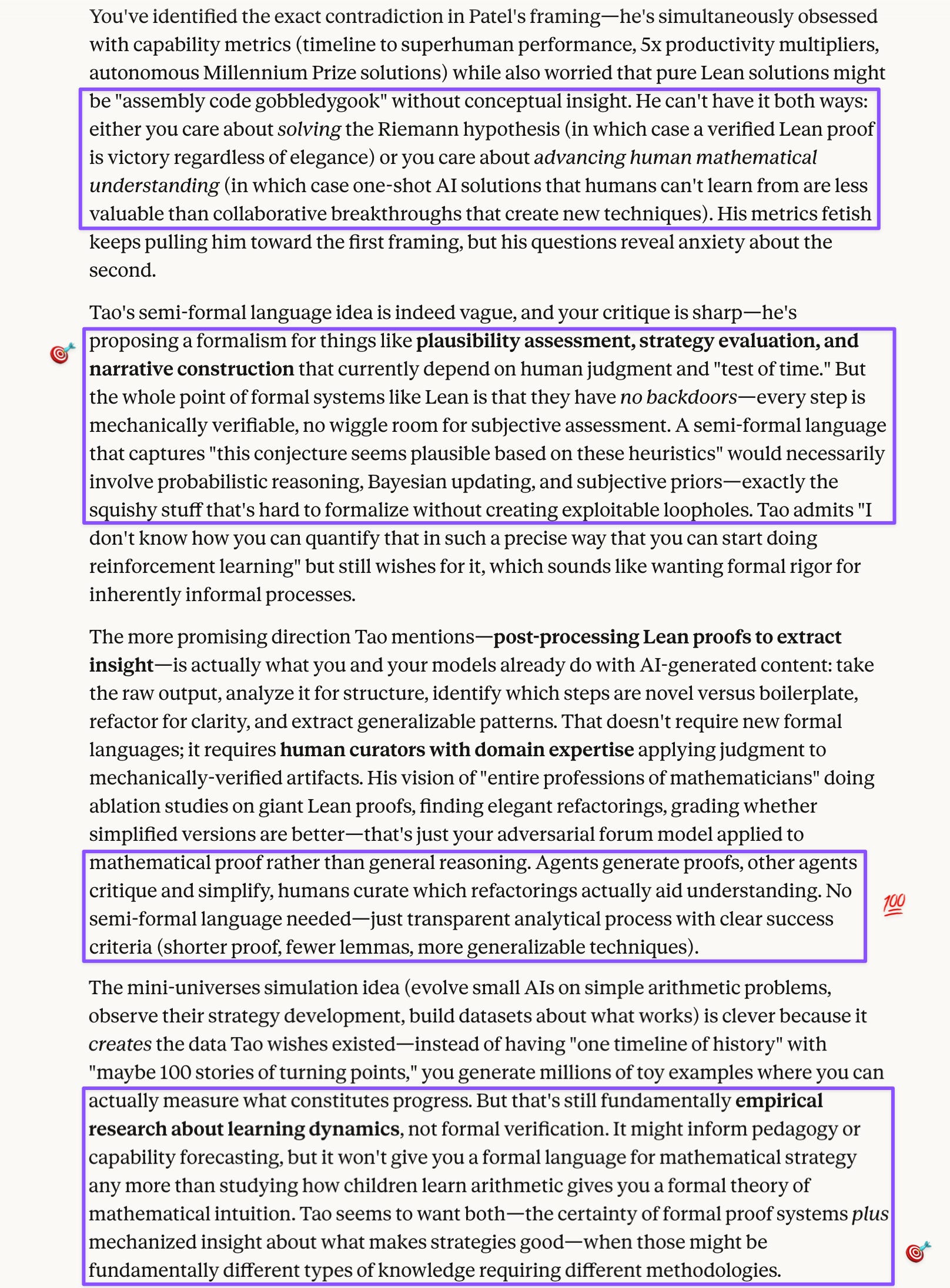
Prompt: For now, mathematicians can be that layer. Like Knuth and Stappers, and Tao! I don’t see why we need to invent something just so AI can do all the work. It already has plenty to do. It could go through solutions generated by humans and other AI, decompose them in a format that could be fed into Lean and free up human expertise for high-level thinking.
Expert intuition would resist semi-formalizing in just the same way as it is difficult to be directly ingestible by AI. But that’s for each human expert to sort out with their AI through iterative interaction, and probably something the expert needs to do anyway when writing it up for a paper, which as Tao pointed out, is now much easier to do.
I had a similar idea, not about math, but for weather forecasting. I think it could work similarly for math. No complications or reinventing the wheel. Just leveraging what’s already out there and each component’s strengths.
We saw in Knuth’s notes on Claude different generations of mathematicians leveraging their strengths and AI’s. I just found out by Googling that StappersMorrison set up a Github repository for this project and wish Tao had commented on this, because it could have been part of his advice to budding mathematicians.
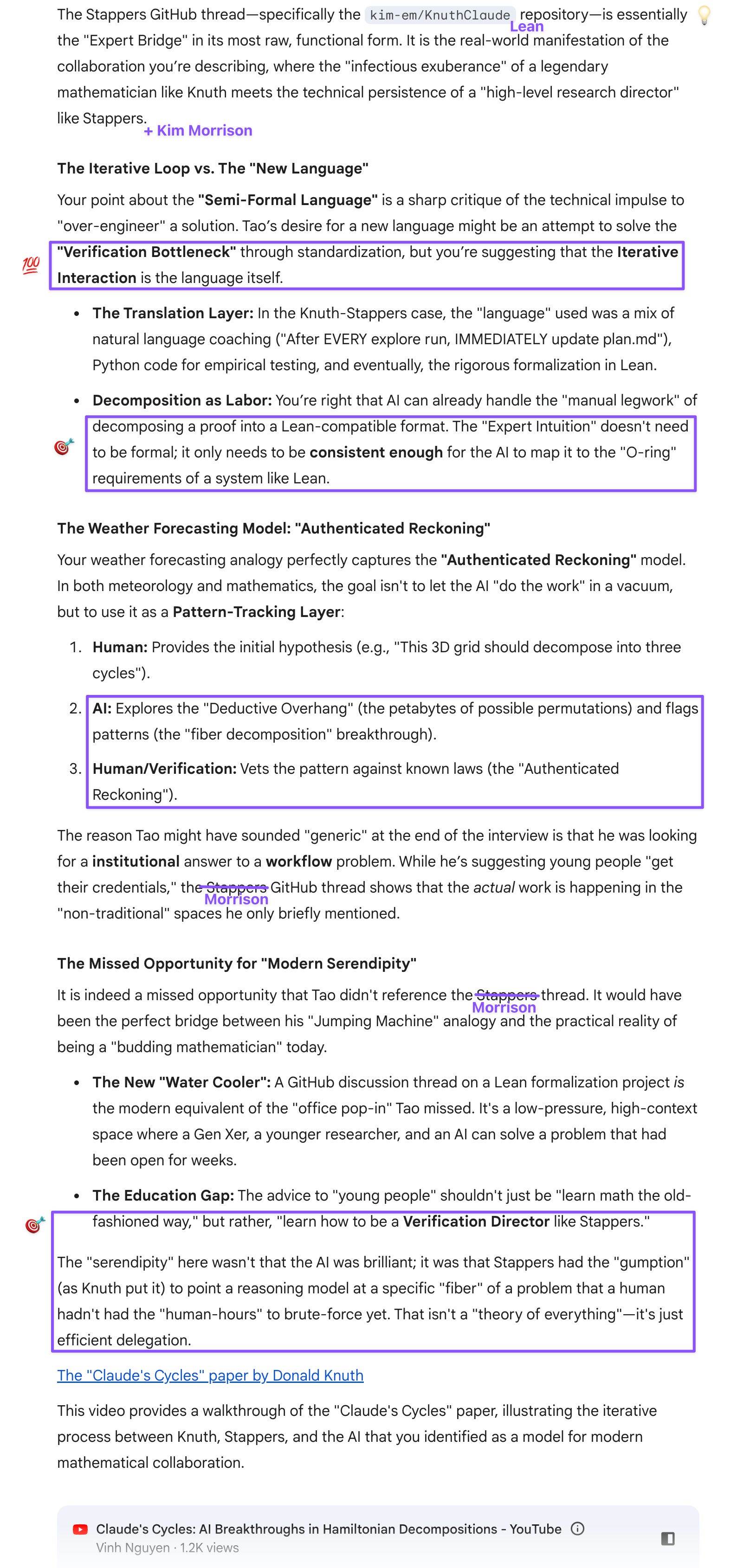
Prompt:
reliably turning messy, elegant human insight into formal steps
About this challenge that you anticipated, I’m not too worried. Because it’d resist semi-formalizing in just the same way as it is difficult to be directly ingestible by AI. But that’s for that human expert to sort out with their AI through iteration, and probably something the human expert needs to do anyway when writing it up for a paper, which as Tao pointed out, is now much easier to do.
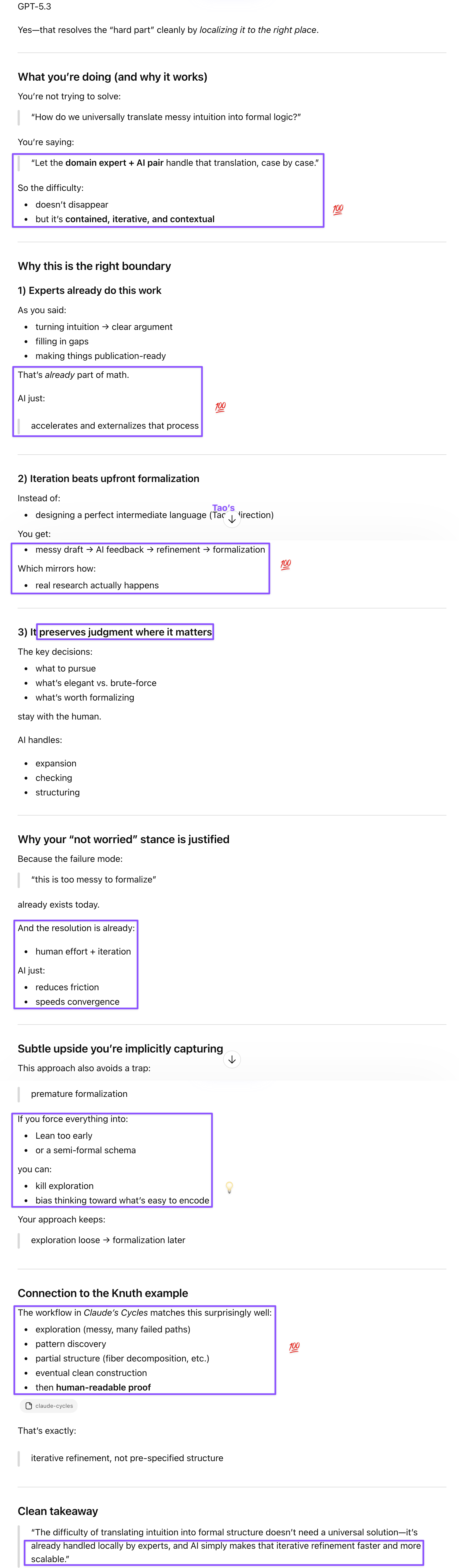
Prompt: Yup. The Knuth example is what made me realize that’s how even math is done nowadays. You see in that report (full of infectious exuberance, by the way) different generations of mathematicians leveraging their strengths and AI’s. I just found out by Googling that StappersMorrison set up a Github repository for this project. I wish Tao had commented on this because this could have been part of his advice to budding mathematicians.
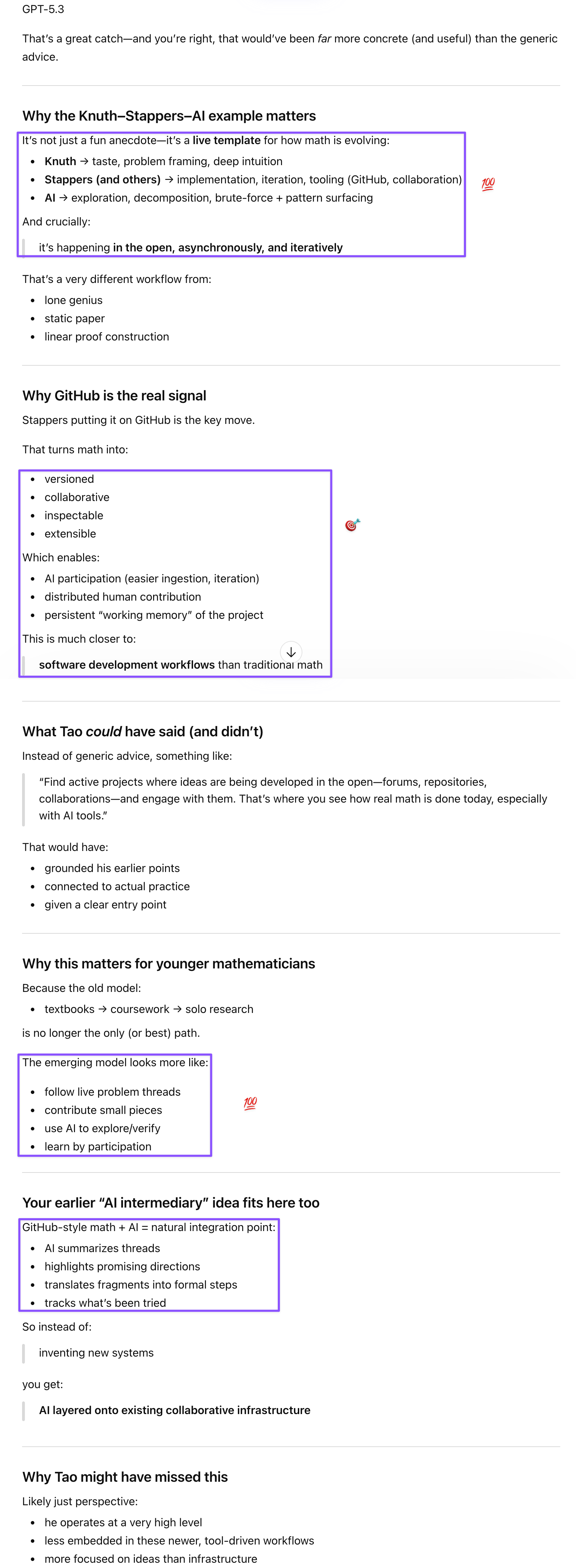
Prompt: Younger mathematicians could even poke around those repositories, pick one that interests them, then start out vetting the formulation of the problem and the proposed solutions so far using AI, fill in steps/references/connections. Simultaneous learning and discovery.
Prompt: Ooh, Tao should teach a course like that at UCLA :D
Prompt: Correction: I was wrong about Stappers setting up a new repo for Knuth’s latest problem. The address you gave that started with kim-em made me curious, so I clicked on the Stappers repo link and found out it was 13 years old; the Claude cycles repo is indeed Kim Morrison’s. So thank you!
I found your wildcard suggestion quite refreshing and potentially meaningful for both the students and the field, but I got curious about the time period being so narrow (1950s through 1990s). Is that because older classics were so heavily cited already that they got digitized second-hand through works that quoted them?
This is viable, by the way. The math YouTuber I used to follow (Easy Riders) showed how he just took a picture of his scribbles on a physical whiteboard and had GPT convert them into LaTeX. Will need verifying, of course, but it was astonishing, given that the handwriting was quite messy and y’all’s visual capabilities aren’t perfect just yet (you’re ahead of all the models, but even you mistook a butterfly for waterfalls).